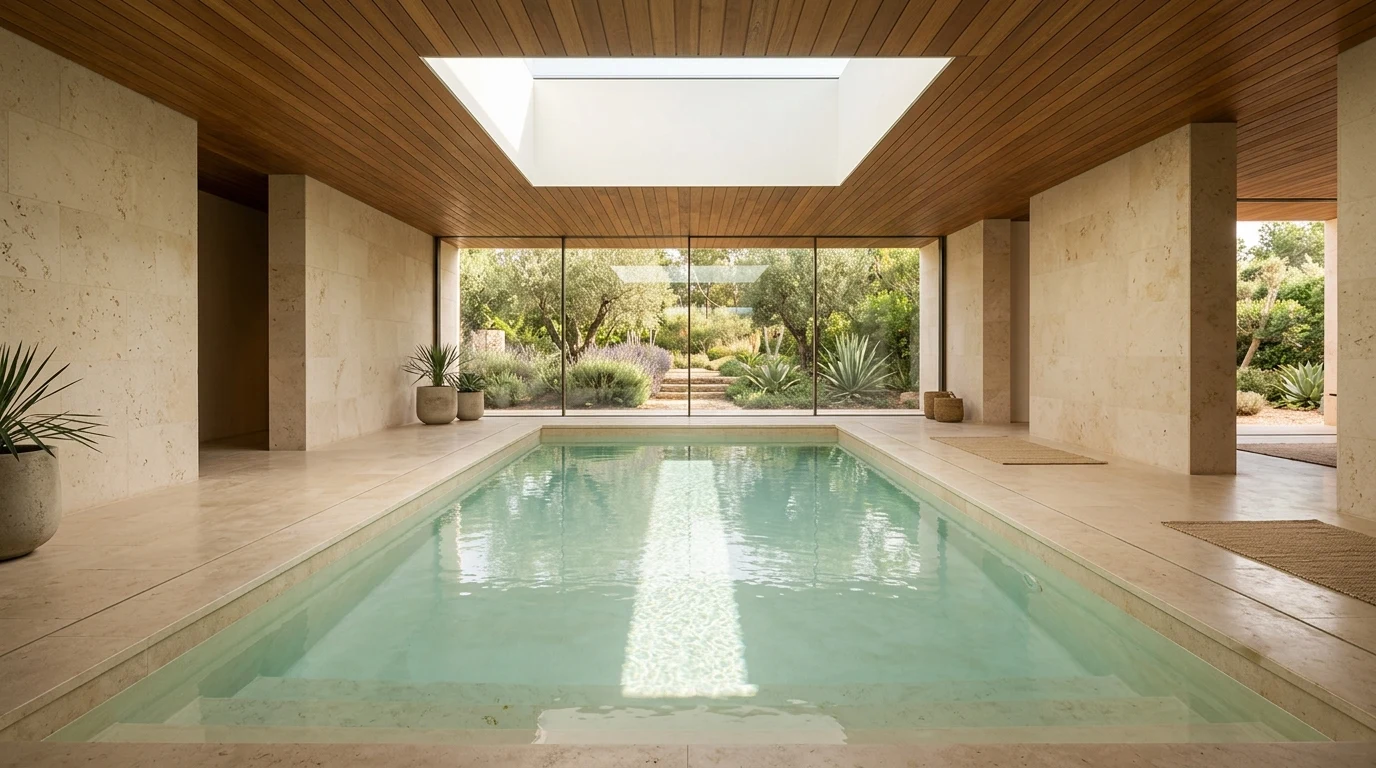
It is also one of the highest-cost and most technically complex investments in a luxury residential project. An indoor pool cannot be added retrospectively to a building that did not contemplate it from the outset: it requires reinforced structure, waterproofing of the entire volume, a dehumidification system specific to the space it occupies, and ventilation that prevents humidity from migrating to the rest of the building. All those requirements must be in the project from the first line.
The space containing the pool: the most important decision
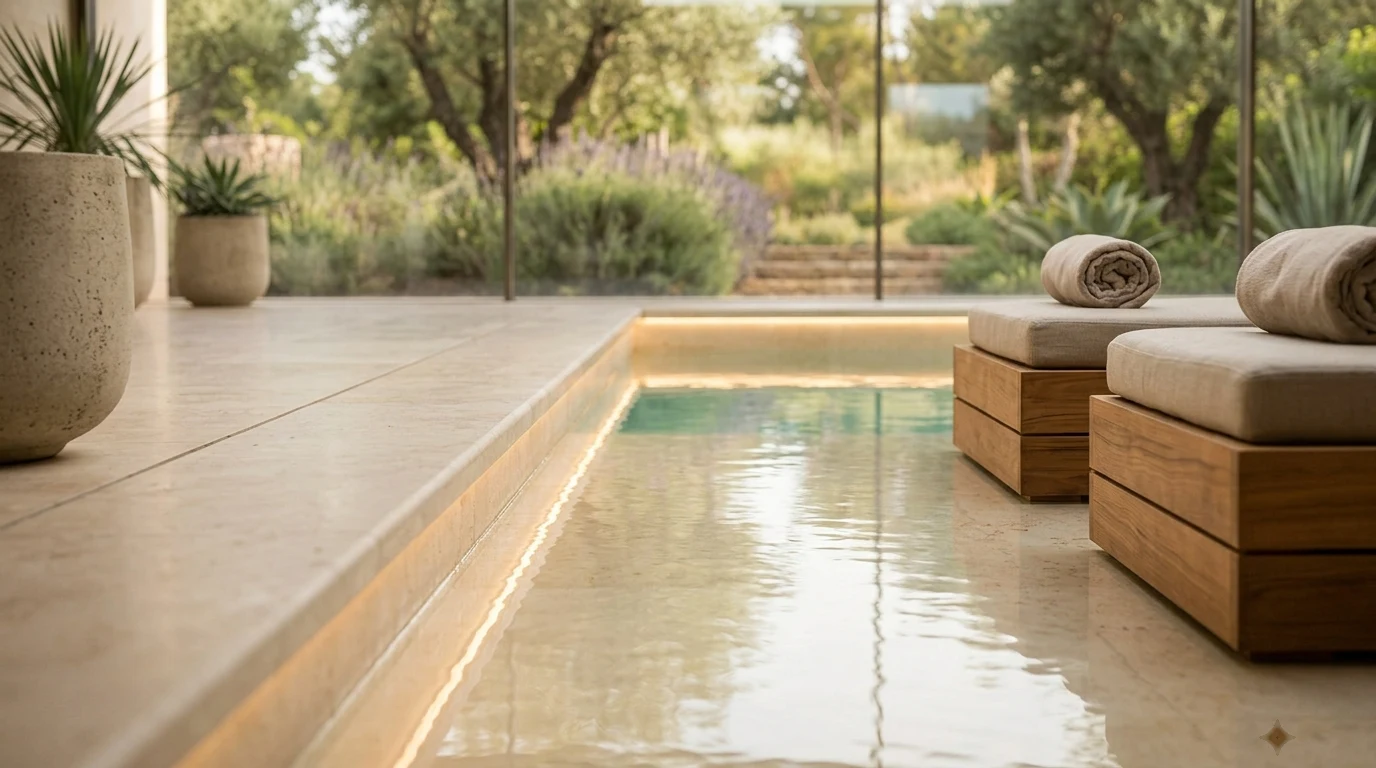
The most important design decision in a private villa indoor pool is not the pool lining or the lighting: it is the space that contains it. The proportion between the pool surface and the perimeter space, the ceiling height, the orientation and dimension of openings to the exterior, and the visual relationship with the garden or landscape determine whether the indoor pool produces wellbeing or confinement.
The minimum space area for an 8×4 metre pool to work well as a wellness room is between 80 and 100 m² total, including the pool and the perimeter circulation and rest zones. A pool fitted to the millimetre in the available space — with barely 60-80 cm of clearance between the pool edge and the wall — produces a confinement experience that no luxury material can compensate for. Ceiling height matters as much as surface area: a 2.7-metre ceiling over an indoor pool produces a cellar sensation; a 4-5 metre ceiling with zenithal skylights produces the sensation of a private pavilion.
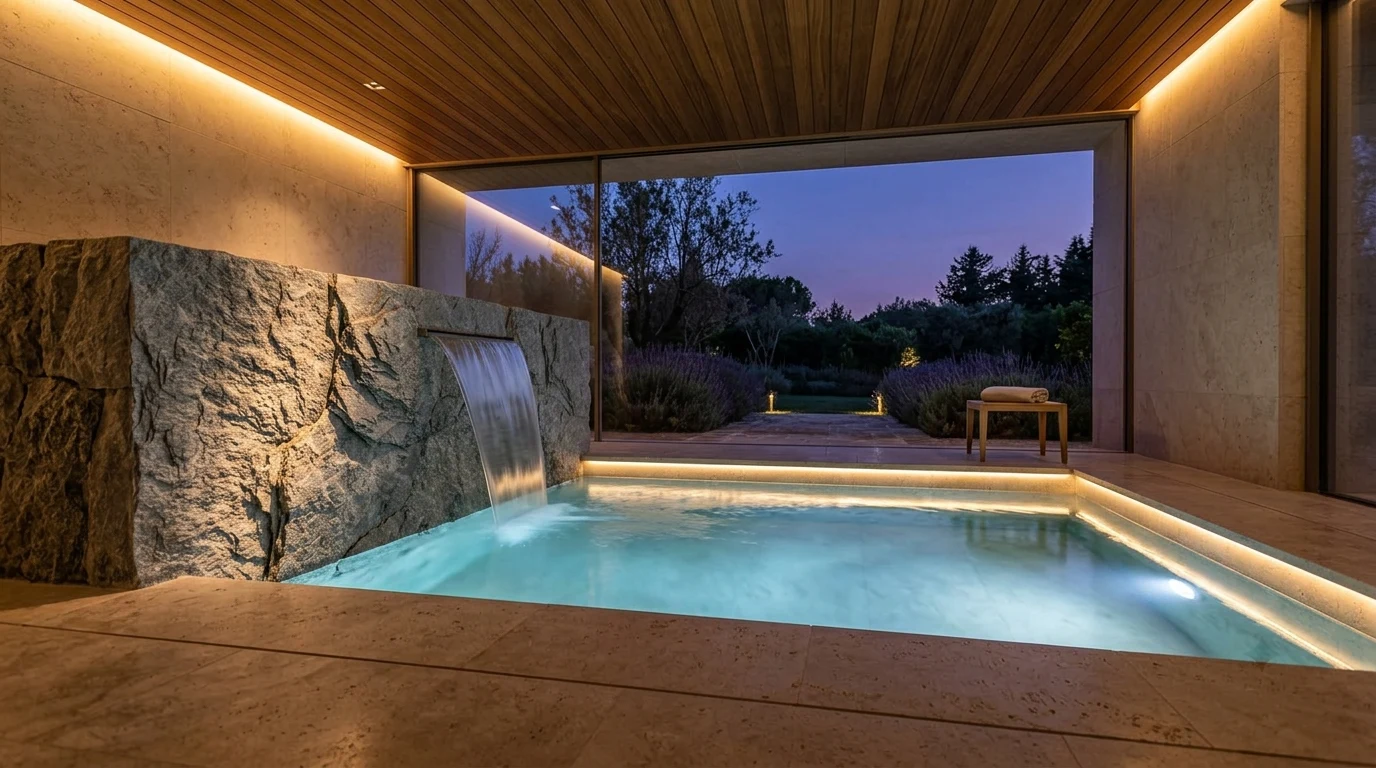
The visual connection to the exterior is the design element that most transforms the experience of an indoor pool. A floor-to-ceiling glass wall giving onto the garden — or, in privileged locations, onto the landscape, river or sea — turns the indoor pool into a space that feels outdoors despite being inside. That connection simultaneously resolves the visual problem of confinement and the technical problem of natural light supply, reducing artificial lighting consumption and improving the perception of the water.
Materials: what lasts and what does not hold up
Large-format porcelain (60×120 cm or 120×120 cm) in a private indoor pool produces a clean, high-end visual result with minimal maintenance and durability above 20 years. In light tones — off-white, cream, soft grey — it produces the illusion of bluer, cleaner water than medium or dark-coloured porcelain. Installation cost in the pool, including coping profiles, ranges between €180 and €350/m² of cladded surface.
Natural stone — Roman travertine, Moleanos limestone, Bianco Carrara marble — produces the most exclusive visual result in a private indoor pool. Its technical limitation: natural stone absorbs water and requires treatment with quality penetrating resin and epoxy chlorine-resistant grout. Without that treatment, stone stains and degrades in under five years. With correct treatment, it can last decades. Cost is 60–150% above porcelain.
Timber on the walls and ceiling of an indoor pool space produces the warmest, most residential image: teak, abachi or red cedar, untreated or with water-repellent oil, that resist humidity without rotting. The combination of stone lining in the pool and timber cladding in the perimeter space produces the greatest contrast of textures and visual temperatures in a private villa indoor pool.
Dehumidification: the system that determines whether everything else works
The greatest technical error in private villa indoor pools: designing the space and materials with criterion but undersizing or ignoring the dehumidification system. The evaporation of an indoor pool of 8×4 metres produces between 20 and 35 litres of water as vapour per hour when water temperature is 28°C and ambient temperature is 26°C. Without a correctly sized dehumidification system, that humidity condenses on cold surfaces — glass, metal profiles, wall faces — and migrates into the rest of the building through thermal bridges. The result is condensation on windows, damp in walls and accelerated deterioration of all materials.
The dehumidification system is a specialised piece of equipment — not a domestic air conditioner — that extracts humidity from the air, heats it and recirculates it maintaining temperature and relative humidity within comfort ranges (26-28°C ambient, 50-60% relative humidity). Cost for a 30-40 m² pool surface ranges between €8,000 and €20,000 for the unit, plus duct installation. It is the investment most frequently cut in the budget and the one that causes the most problems when it is.
Lighting and hydrotherapy: the elements that define the experience
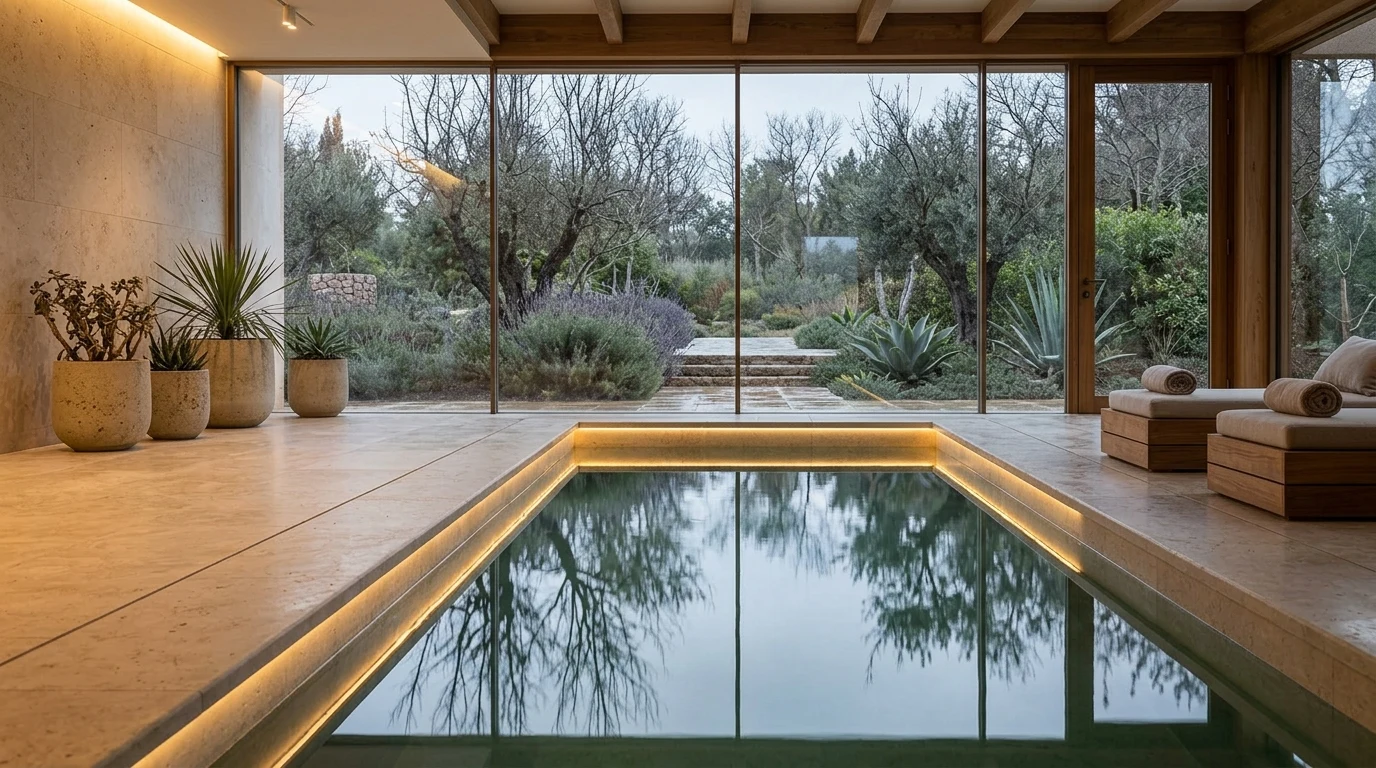
Underwater LED projectors at 12V — never 220V in a residential pool — with colour temperature between 3,000K and 4,000K produce the blue water effect the eye associates with cleanliness and depth. Projectors must be installed in the pool walls, not the floor: light from the floor projects shadows upward that read as unnatural. Perimeter lighting at 2,700K — wall-mounted luminaires, indirect ceiling light, LED strips concealed under the pool coping — produces the warmth that contrasts with the blue of the water and turns the indoor pool into a space of visual wellbeing rather than a technical space.
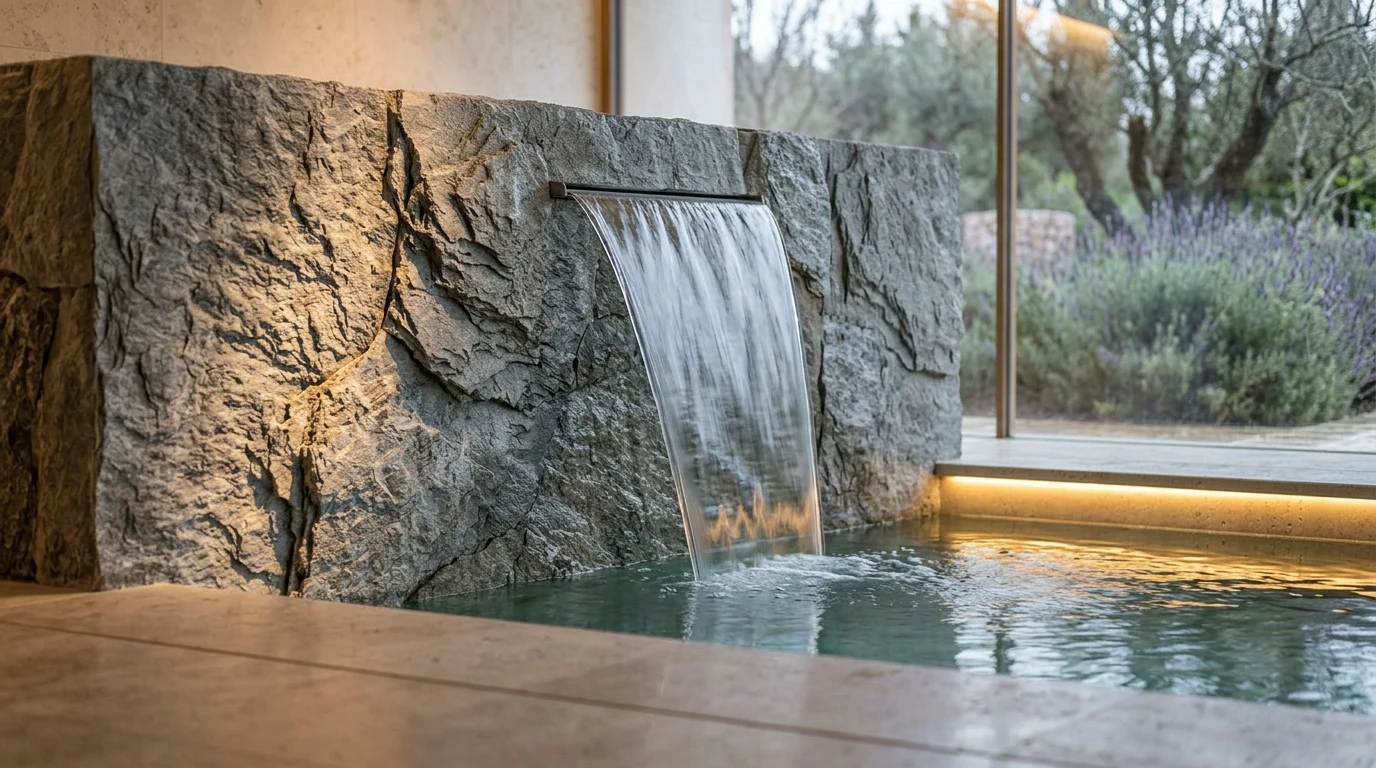
Hydrotherapy elements — wall waterfall, massage jets in the pool walls, bubble bench, counter-current — are the experience differential between an indoor pool and a complete aquatic wellness space. In a private luxury villa, the wall-integrated waterfall is the highest visual and sensory impact element at the most contained cost: between €3,000 and €8,000 depending on material and dimensions.
Indoor pool as a holiday rental argument
In the luxury holiday rental market in Spain and Portugal, a villa with an indoor pool commands a different category to one with an outdoor pool only. A 6-8 person villa in Portugal with an indoor pool can be rented in January at rates of €1,500–3,000 per week that the same villa without an indoor pool cannot sustain. A €200,000 investment in an indoor pool that generates €50,000 in additional annual low-season rental income amortises in 4–5 years.
Wellness space and indoor pool design in private luxury villas in Spain and Portugal is one of Véline Interiors' specialisms. If you have a project and want to evaluate the technical feasibility and return of an indoor pool, the conversation is open.
Véline Interiors · Wellness Design
Have a project with an indoor pool?
We evaluate the technical feasibility and return of an indoor pool in your villa.
Submit your project →