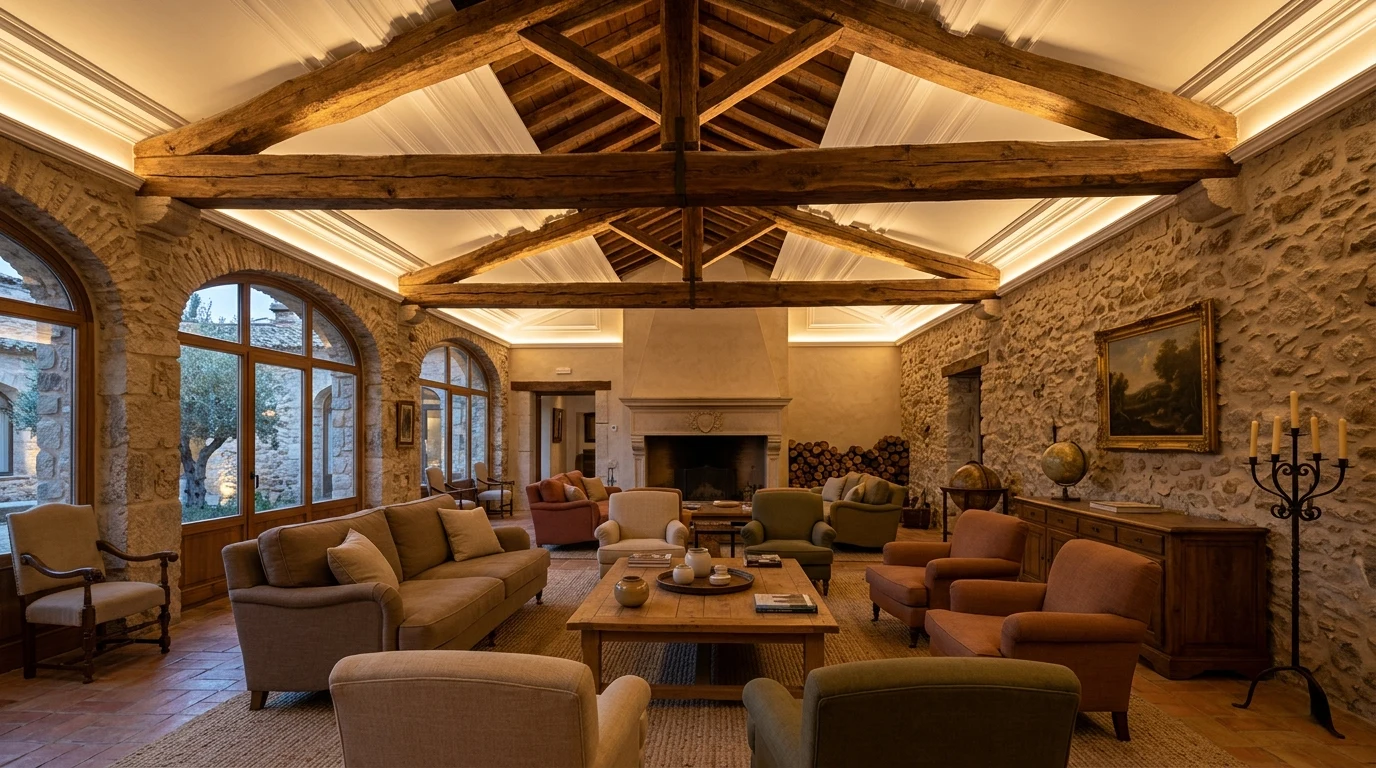
Lighting is not the last step of an interior design project. It is the decision that determines whether everything else works.
This article analyses, zone by zone, how to design lighting for a rural luxury hotel so that the guest arrives, looks up, and decides they want to come back.
Why lighting is the differential argument of a rural hotel against its competition
The guest who chooses a rural luxury hotel in Spain or Portugal is not looking for the same thing as someone who chooses an urban five-star. They are looking for authenticity, calm and a relationship with the place that cannot be found anywhere else. What they are looking for, in design terms, is for the space to tell them something: that the beam is a hundred years old, that the stone was laid by someone long gone, that the fireplace has warmed other lives before theirs.
Lighting is the narrator of that story. Under cold, uniform light, the chestnut beam looks like generic timber from a hardware store. Under raking light at 2,700K, that same beam reveals its texture, its wear and its history. The guest does not analyse this consciously: they feel it. And that feeling is exactly what converts one night into a five-star review, and a five-star review into a direct booking the following year.
Data from the luxury hotel sector indicates that hotels with a differentiated lighting proposal — one that integrates existing architecture as a visual argument — achieve between 15% and 30% higher scores in review platforms under "atmosphere" and "design" categories. Those categories are directly monetisable in rate.
Timber beams and structural elements: raking light, never direct
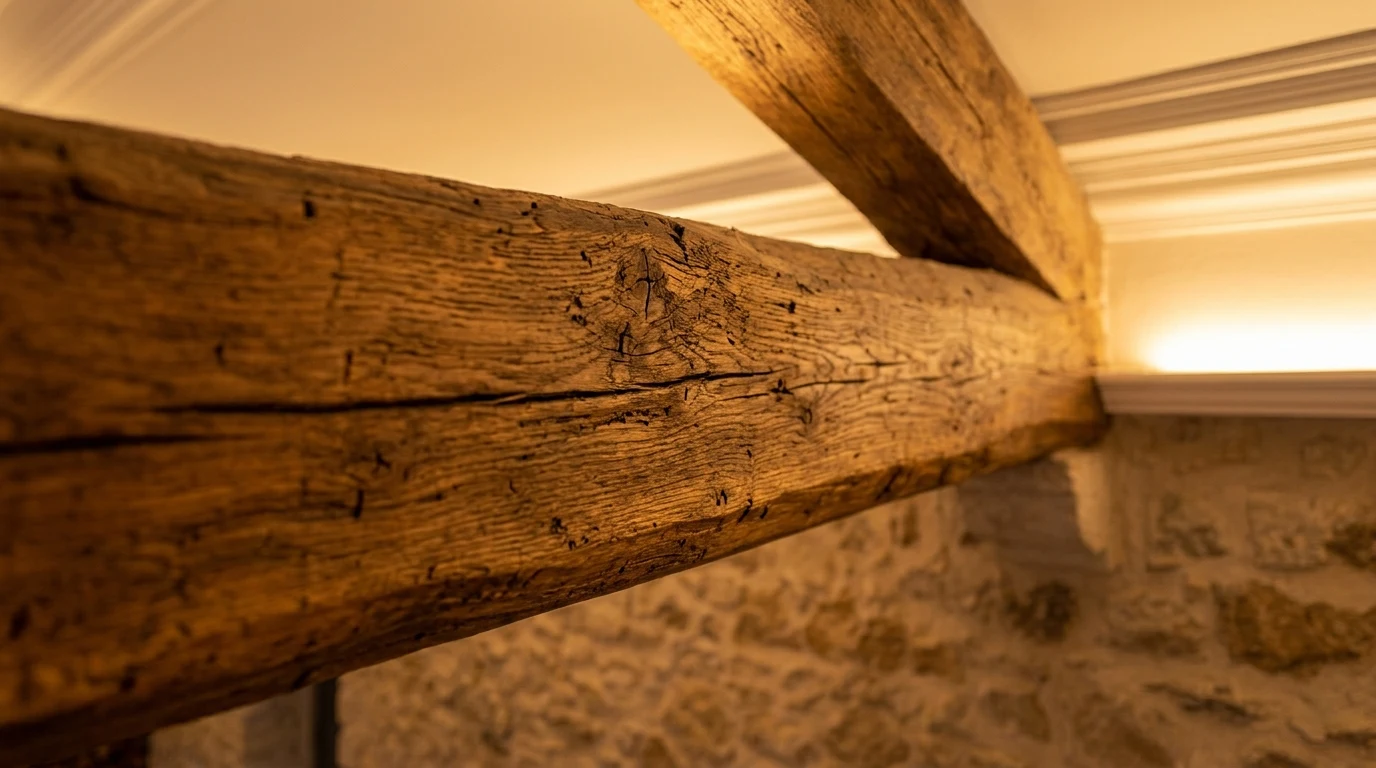
The structural beam — chestnut, oak, resinous pine — is the most photographed element of rural luxury hotels and the most frequently poorly lit. The canonical error: a centred downlight in the ceiling that illuminates the floor and leaves the beam in shadow, or worse, a projector aimed directly at the timber that flattens it visually.
The timber beam works well with raking light: a light source positioned perpendicular to the beam, at close range, that grazes the surface and reveals its texture. That technique — called grazing in technical lighting — makes every fibre, crack and knot visible. The result is timber that looks alive rather than decorative.
Specific technical criteria: narrow-angle adjustable projector (10°–15°), colour temperature 2,700K, minimum CRI 90 to faithfully reproduce the warm tones of aged timber, positioned between 30 and 60 cm from the beam depending on its section. For large-section beams — over 25 cm wide — lighting from both sides can be used to reveal three-dimensionality.
In salons with several parallel beams, the system must be dimmable: during the day, with abundant natural light, beam lighting can be off or at low intensity. At dusk, when natural light disappears, the illuminated beams become the element defining the character of the space. That moment — the hotel lighting up as evening falls — is one of the most powerful in terms of guest experience.
Neoclassical mouldings and worked ceilings: light that reveals volume
The farmhouses and pazos of northern Spain and the quintas of the Minho and Douro share a feature: their ceilings have work. Plaster mouldings, rosettes, cornices, coffered panels. Those elements were designed to be seen by candlelight — light that moves, projects shifting shadows and changes with the source angle.
The modern lighting that most closely approximates that effect is high-CRI indirect light that washes the ceiling: LED strips concealed in a lower perimeter moulding projecting upward, revealing the volume of the cornice and central rosette without directly lighting the guest. The result is a ceiling that appears to float over the space, with depth and shadow in the relief.
What does not work: a recessed downlight centred in the rosette. That downlight flattens the rosette by eliminating the shadows that give it volume. An 18th-century rosette without shadow is indistinguishable from a polystyrene rosette from a DIY store. Light creates the difference, not the material. For cornices and perimeter mouldings, the LED profile must be entirely concealed and must use a diffuser to avoid hot spots. Ceiling colour temperature: 2,700K — so the white of the plasterwork reads as warm ivory, not hospital white.
The fireplace: the element that needs no competition
A lit fireplace produces light at approximately 1,800K — warmer than any artificial source — and a variable luminous intensity that no electrical system can replicate. It is the most powerful lighting element in a rural luxury hotel and the one most easily destroyed.
The way to destroy it: install spotlights or wall lights near the fireplace that compete with it in intensity. When there is an artificial light source at the same height as the fire and at greater intensity, the fire loses. Visually it stops being the protagonist and becomes a minor decorative element. The guest stops looking at it.
The correct criterion: when the fireplace is lit, all artificial lighting in the salon must be at an intensity lower than the fire. This requires dimmable systems — analogue dimmer or DALI protocol — that allow general lighting to be brought down to between 10% and 20% of maximum. At that level, the fire illuminates, the artificial sources accompany, and the space acquires an emotional temperature the guest will remember.
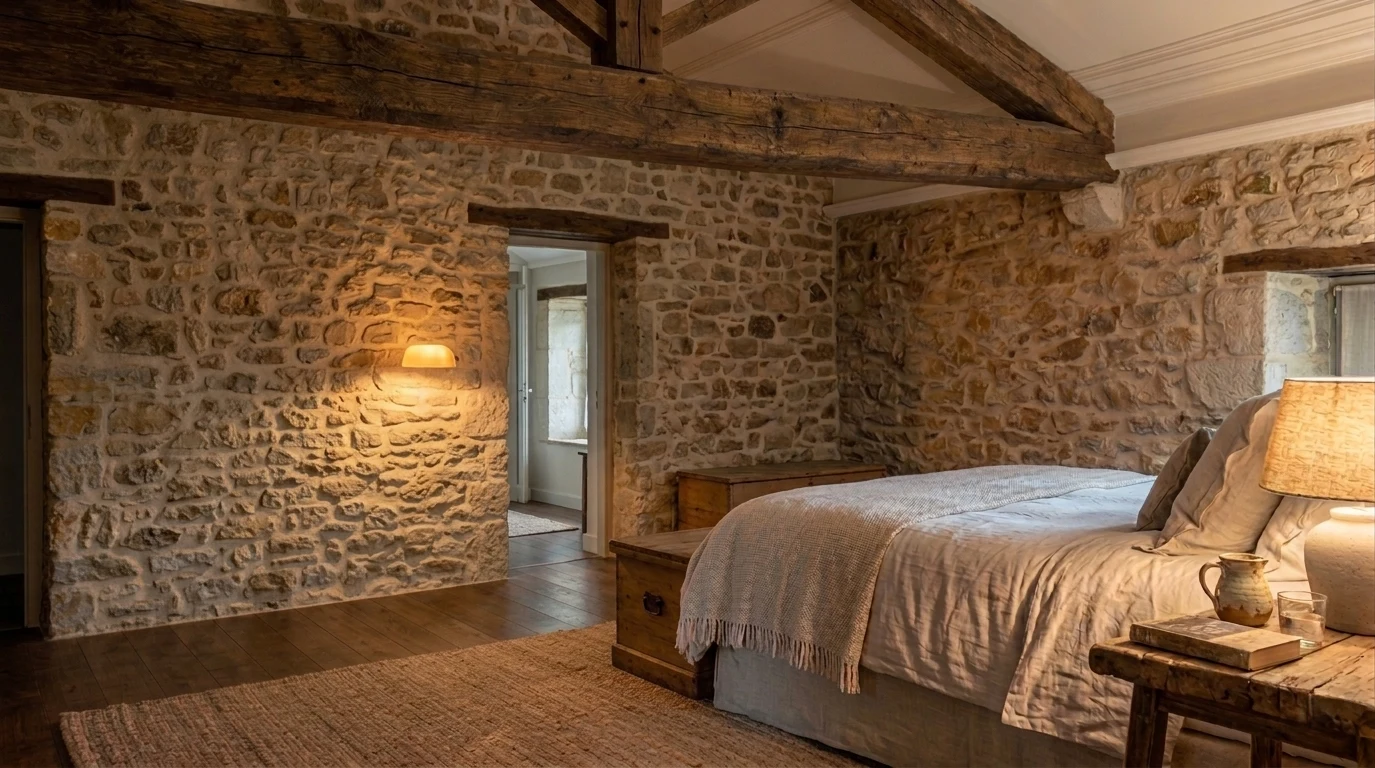
For bedrooms with fireplaces — one of the most powerful rate arguments in rural luxury hotels in Spain and Portugal — bedside lighting must be independent of the fireplace system and controllable from the bed. The guest reading by the fire needs bedside light; the guest who wants to fall asleep watching the flames needs that same light to disappear without getting up.
The rural dining room: how lighting turns dinner into a gastronomic experience
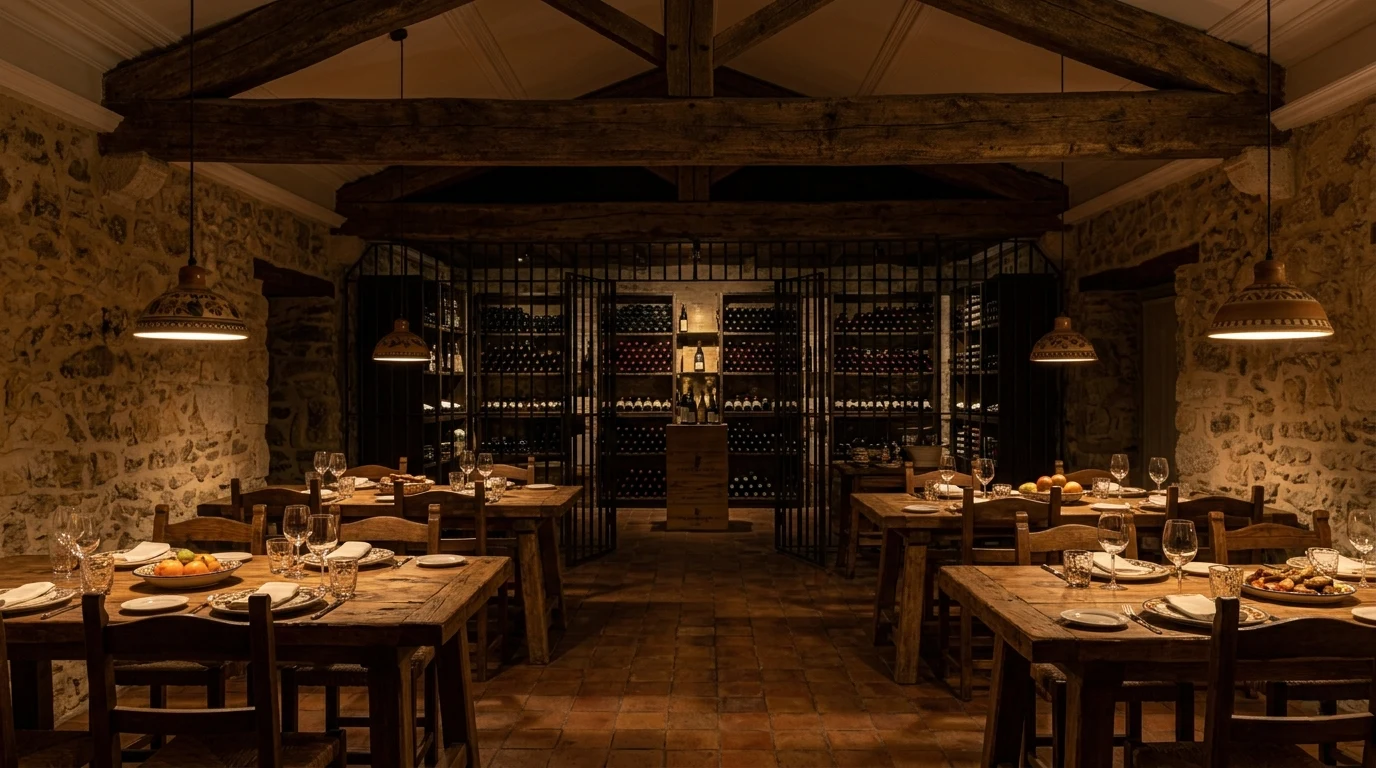
The dining room is the space where lighting has the greatest direct impact on hotel revenue. A Lighting Research Center (LRC) study concludes that appropriate lighting in dining spaces improves perceived wellbeing, reduces stress and increases the guest's time at table. In a rural hotel where dinner is part of the product — and frequently the highest-revenue moment per guest — that dwell time translates into cellar sales, pairings, desserts.
The criterion for rural luxury hotel dining rooms: over-table illumination between 150 and 200 lux, colour temperature 2,700K, minimum CRI 95 so food and wines maintain their true colour. The light source must be over the table, not over the service aisle or the guest's head. A guest receiving direct overhead light is uncomfortable without knowing why.
Artisan pendant lights — local ceramics, esparto grass, wrought iron — have dual value in a rural hotel: functional as a light source and narrative as an object. A ceramic pendant from Talavera over the dining table of an Extremadura farmhouse tells a story. A standard aluminium downlight does not.
For support lighting — the back of the room, the visible cellar, shelving of local product — intensity should be at least 50% lower than the tables. The contrast between the well-lit table and the dark background is what creates intimacy and the sense that dinner is an event.
The nocturnal exterior: the first direct-booking argument
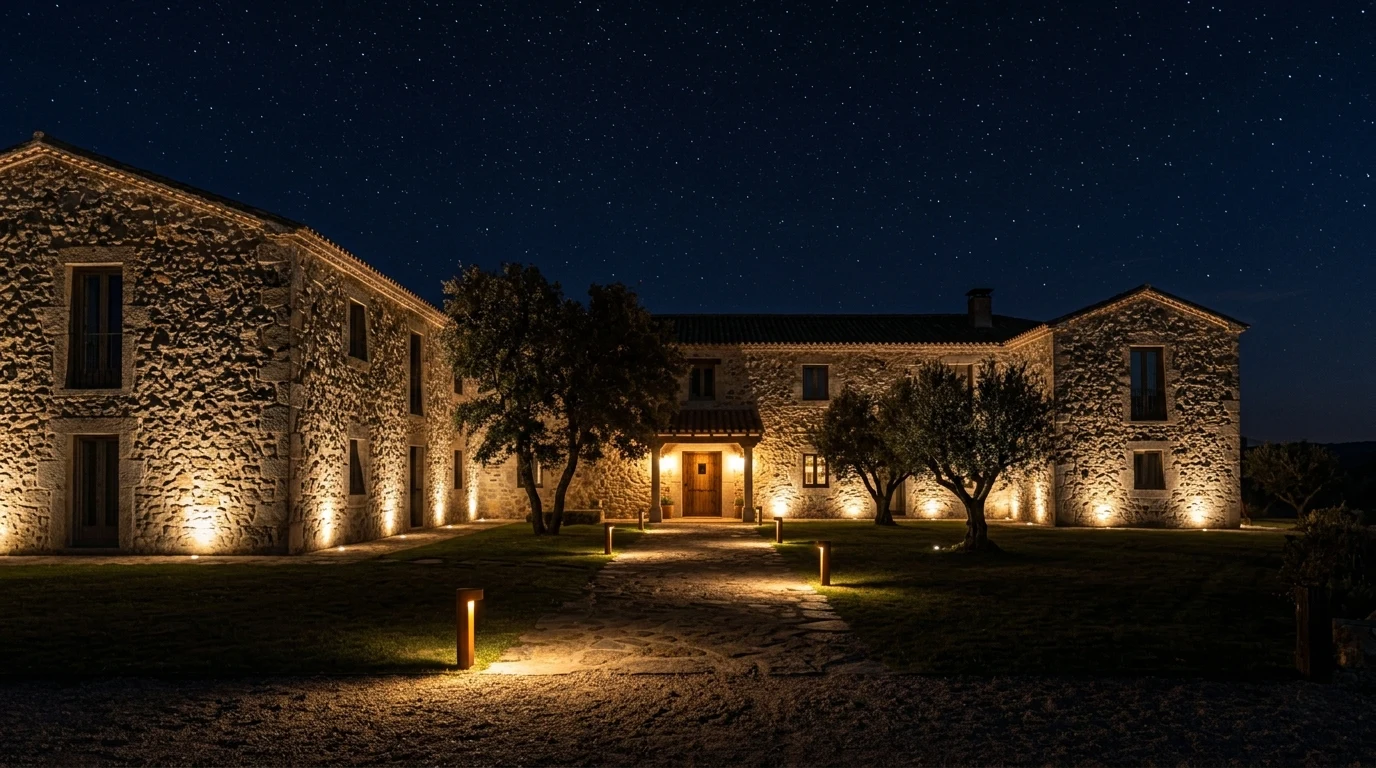
The nocturnal exterior of a rural luxury hotel is the image that appears on Instagram, in travel features and in the photographs guests take on arrival or departure. It is also the guest's first visual contact when arriving at night — which at mid-latitudes in Spain and Portugal occurs from six in the evening in winter season.
That first impression is unrecoverable. A rural hotel with a dark facade or cold sodium lighting produces a sense of abandonment that even the most considered interior cannot fully compensate. A rural hotel with a facade lit at 2,700K, a garden with warm ground-level light points and an entrance defined by warm directed light produces — before the door opens — the sensation that someone thought carefully about the guest's arrival.
Criteria by exterior zone: Facade — ground-level projectors aimed upward (up-lighting) at 2,700K, revealing the texture of stone or lime render. Avoid uniform illumination of the entire facade: contrast between lit zones and shadow is what gives it character. Garden and pathways — low-level ground bollards, never tall lampposts that contaminate the night sky and destroy the darkness the guest came to find. In astrotourism contexts or Starlight-certified areas, the hotel's own light pollution is a quality variable to manage. Outdoor pool — underwater lighting at 2,700K or 3,000K, never blue or cold light that converts the pool into a sports facility. A pool lit warmly at night is one of the most photographed and shared elements of a rural hotel. Entrance and arrival zone — directed light that defines the route without dazzling: the guest must see where to go, not stare at the light source.
How much does a professional lighting project cost for a rural luxury hotel?
A professional lighting project for a rural luxury hotel of 10–20 rooms typically represents between 3% and 6% of the total interior design budget. On a reform project with an interiors budget of €400,000–800,000, the complete lighting chapter — design, fittings and installation — typically sits between €40,000 and €90,000. The difference between a generic installation and a design specific to the building rarely exceeds €15,000–20,000 in fittings and project fees. The impact on guest experience, hotel photography and direct bookings more than covers that difference in the first season.
High-quality LED with CRI above 90 and 50,000-hour lifespan costs 10–15% more at purchase than standard LED. In a rural hotel with an average of 4,000 operating hours per year, that LED does not require replacement for over twelve years. Maintenance cost is negligible and energy saving versus halogen or fluorescent reaches 80%.
Lighting as a positioning argument, not just a design one
A rural luxury hotel competes in a market where differentiation is increasingly difficult. The farmhouses are similar, the breakfasts are similar, the mattresses are similar. What is not similar is how the space feels at nine in the evening, with the fire lit, the beams illuminated and the cellar half-hidden in shadow.
That feeling does not happen on its own. It is the result of very specific design decisions: what colour temperature each circuit carries, at what intensity each group is regulated, which objects receive light and which remain in shadow. These are decisions that a well-considered lighting project takes with criterion, and that a generic installation leaves to chance.
Interior design for rural luxury hotels in Spain and Portugal is one of Véline Interiors' specialisms.
Véline Interiors · Hospitality Design
Have a reform or new opening project?
If you want to evaluate how lighting can become a positioning argument, the conversation is open.
Present your project →