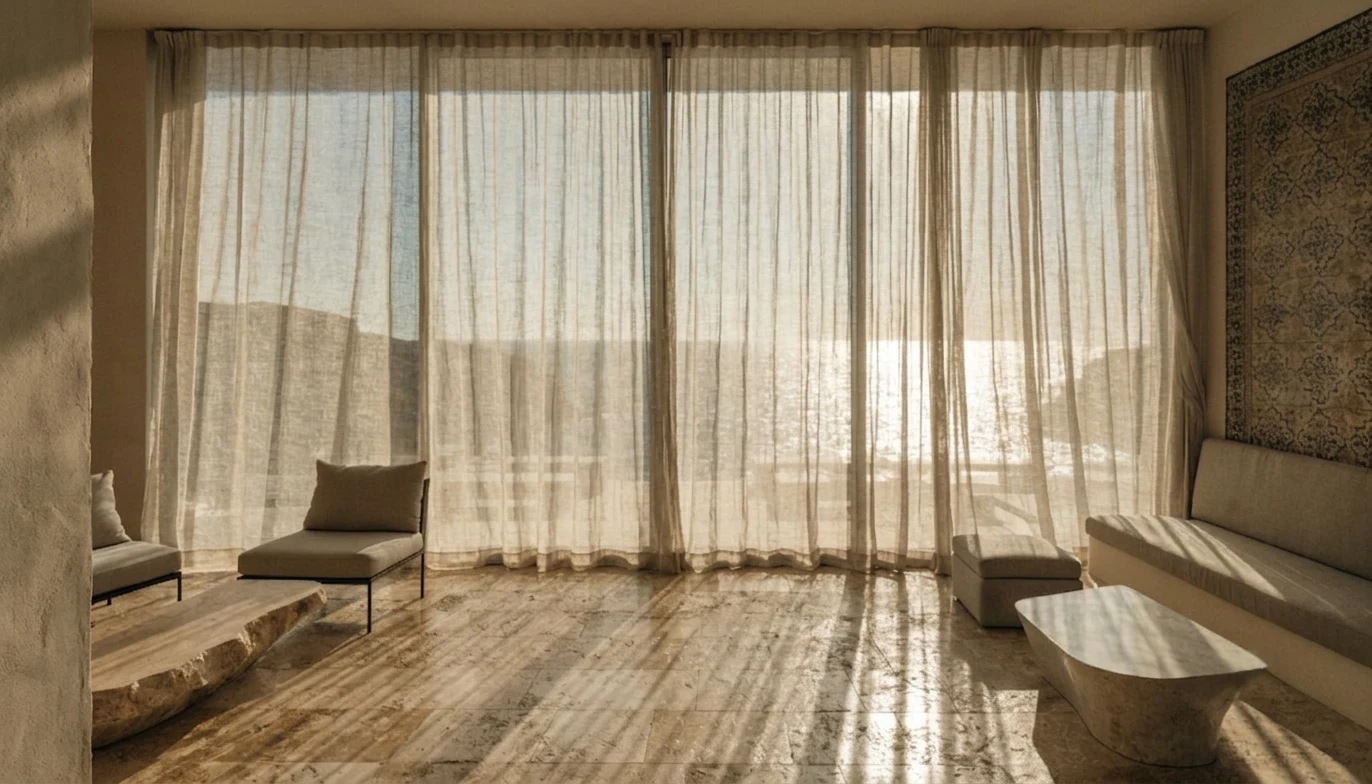
The Algarve has an established luxury hotel industry, with names like Vila Vita Parc, Conrad Algarve or EPIC SANA competing for the high-net-worth guest. But the public conversation around these spaces almost always stops at the result — pools, spa, views — and rarely engages with the design judgement behind them. That's the gap this article addresses: not a list of beautiful resorts, but a reading of the interior decisions that actually work on this specific coastline.
Atlantic light: why the Algarve calls for a different colour reading
Algarve light isn't Mediterranean light, though tourism marketing treats them as interchangeable. It's Atlantic light: more lateral, more variable through the day, carrying a marine humidity that saturates colour differently than the dry light of Ibiza or the Cyclades. A pure white that reads clean in Santorini can read cold and flat under the morning haze common on the region's western coast.
This has a direct consequence for palette. Warm whites — cream or bone-based, never titanium-pure — absorb that lighting variability better. Earth-tone palettes are gaining ground in 2026 against the cool white that dominated the previous decade: terracotta, sand, olive green and chocolate brown are consolidating as the base palette in luxury projects, marking a clear shift toward warmth after years of neutral minimalism.
For a resort, this isn't an abstract aesthetic choice: it's an operational one. A west-facing façade or lobby receives very different light at midday and at dusk, and the palette needs to hold both moments without breaking. The working principle here is to test colour on site, at different hours, before committing it to a paint chart.
Materials that survive salt air and sun without losing character
The Algarve punishes materials. Salt spray, marine humidity and intense sun exposure for much of the year demand specifications that many generic "coastal style" projects ignore, prioritising appearance over medium-term performance.
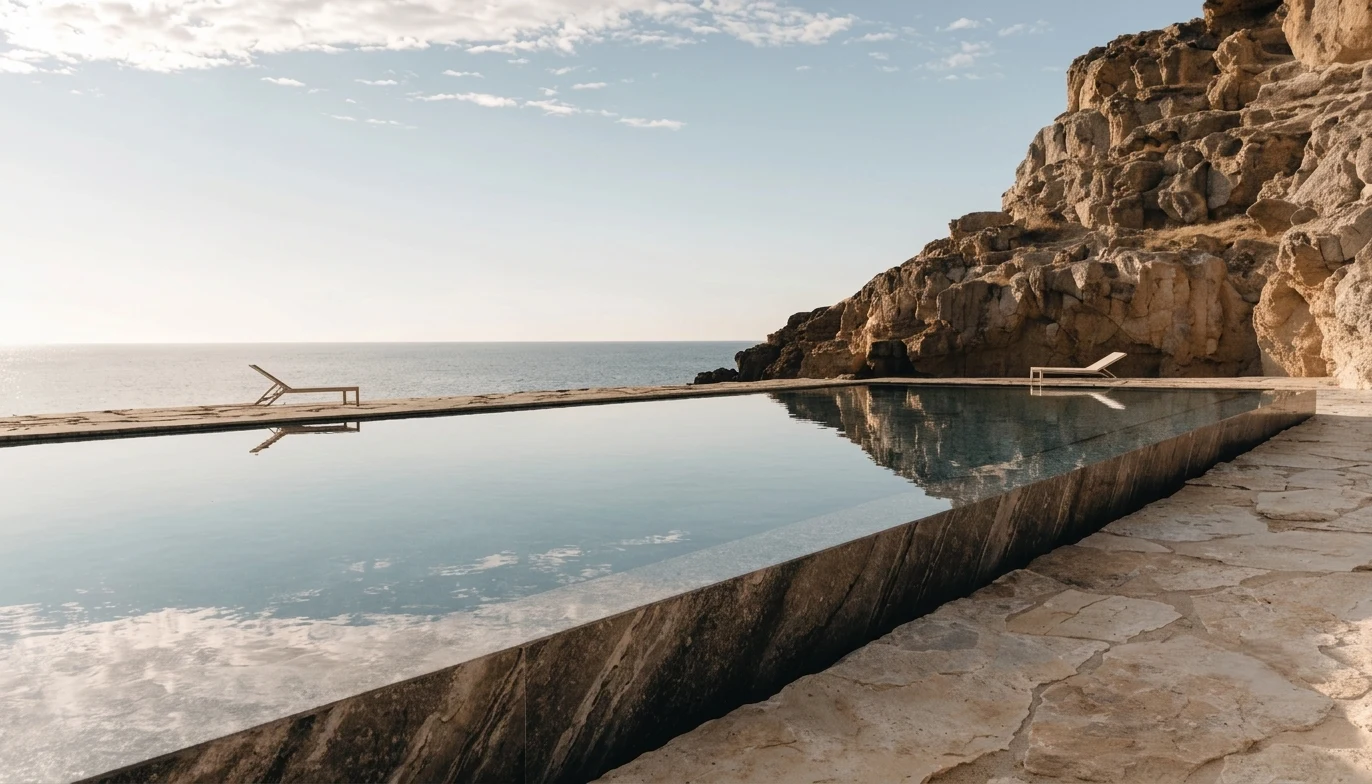
Three materials carry much of the region's vocabulary and, properly specified, solve the problem rather than fight it:
- Traditional Portuguese azulejo tile. Not as an isolated decorative reference, but as functional cladding in wet and high-traffic zones. It resists humidity better than many imported finishes and roots the project in Portugal rather than in a generic "southern Europe."
- Local limestone. In exterior flooring and façade detail alike. It ages with dignity against salt exposure, something treated timber or exterior composite rarely achieves without constant maintenance.
- Lime plaster. As a wall finish instead of plastic paint. It lets the wall breathe, reducing damp-related pathologies, and its matte texture absorbs Atlantic light better than a smooth, glossy finish.
The underlying rule is simple: the material that already works in the region's traditional construction almost always solves the climate problem better than its imported substitute. Sustainability here functions as a technical criterion rather than a marketing label.
From turquoise pool to quiet luxury: the shift toward dark stone
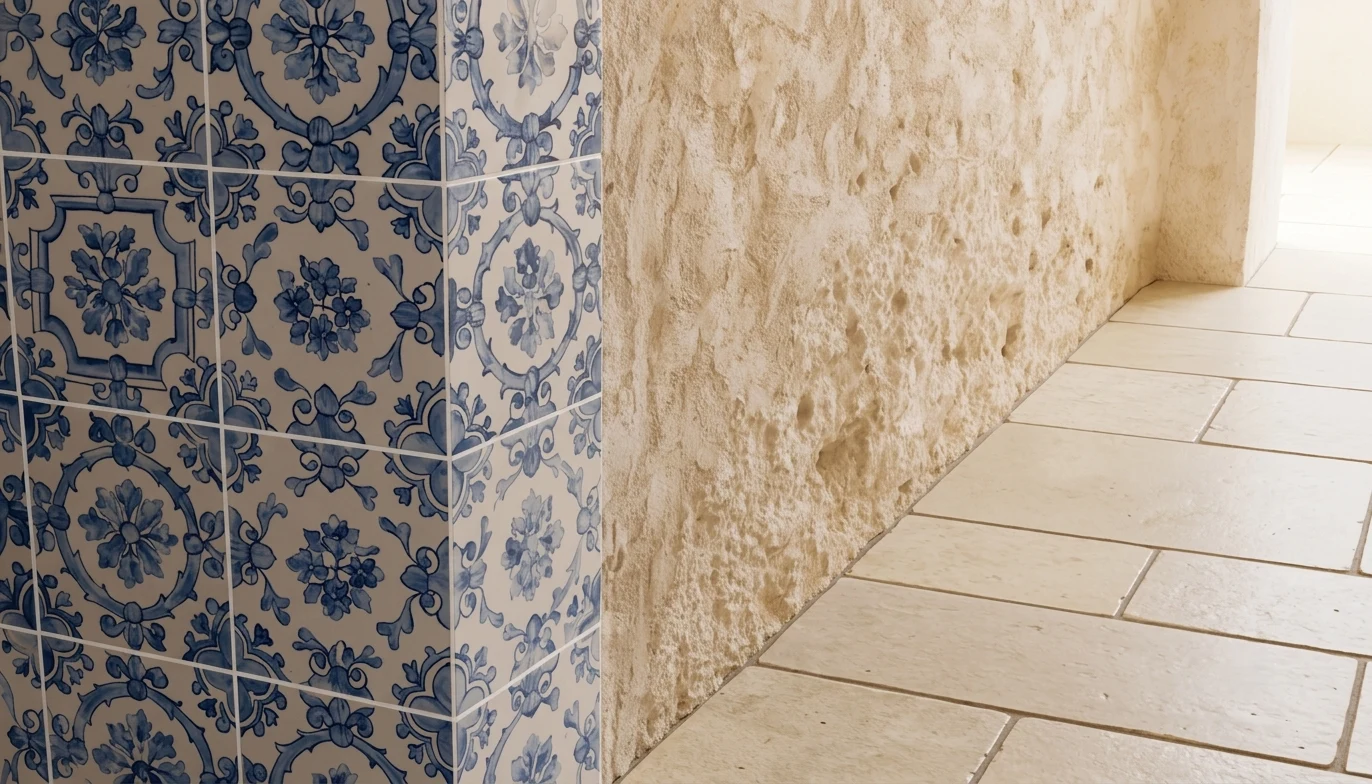
For decades, the turquoise mosaic pool was the visual shorthand for a holiday resort. In 2026 that code is shifting. High-end projects are cladding pools in dark natural materials — grey quartzite, brushed black granite, volcanic stone — that visually erase the water's edge and merge it with the landscape, instead of competing with it through artificial colour.
For an Algarve resort, this decision has its own logic: dark water reflects sky and ocean rather than imposing a municipal-pool blue. It also aligns with the sector's broader move toward quiet luxury: neutral palettes, soft textures, and attention to proportion and material quality over visual statement. The high-net-worth guest seeking exclusivity in 2026 isn't after colour ostentation — they're after serenity built with judgement.
Wet zones and communal areas: the operational judgement
A resort isn't an urban hotel with more square metres. It carries a very different proportion of wet zones — spa, pools, changing areas, shaded terraces — and that changes the priorities of the interior project entirely.
Biophilic design stops being a decorative planter in the lobby and becomes integrated into the architecture of the wellness zones themselves: interior courtyards, natural cross-ventilation and porous materials that manage humidity without relying solely on mechanical climate control. At the same time, luxury hospitality is prioritising residential-style comfort in 2026: rooms and suites that feel less like a standardised hotel unit and more like a well-resolved seasonal home, with bespoke joinery and textiles replacing generic pure-contract finishes.
In the Algarve, this translates into concrete decisions: built shade — pergolas, louvres, deep eaves — rather than only movable parasols; natural ventilation in spa and wellness spaces to reduce dependence on air conditioning; and a clear transition between public, semi-private and private zones, mapped from the start of the project rather than patched afterward with signage.
What sets resort interior design apart from an urban hotel?
An Algarve resort dedicates a far larger proportion of its footprint to outdoor and semi-outdoor zones — pools, terraces, gardens, open-air spa — than an urban hotel, where nearly the entire programme sits indoors. This demands designing the indoor-outdoor continuity as the project's central axis, and specifying materials able to withstand sun, salt and humidity consistently, something a city hotel rarely has to manage at that scale.
Material as argument, not as decoration
An Algarve resort that borrows another destination's wardrobe gives up its strongest commercial argument: the place itself. Limestone, azulejo, lime plaster and Atlantic light aren't limitations to disguise with imports — they're the vocabulary that separates a project rooted in its territory from one interchangeable with any other southern European coastline. The quiet luxury defining 2026 rewards exactly this: less statement, more judgement.
Véline Interiors · Hospitality Design
If this judgement fits your resort project in the Algarve, the conversation is open.
We design interior projects for Algarve resorts from the material and light of the place itself.
Present your project →