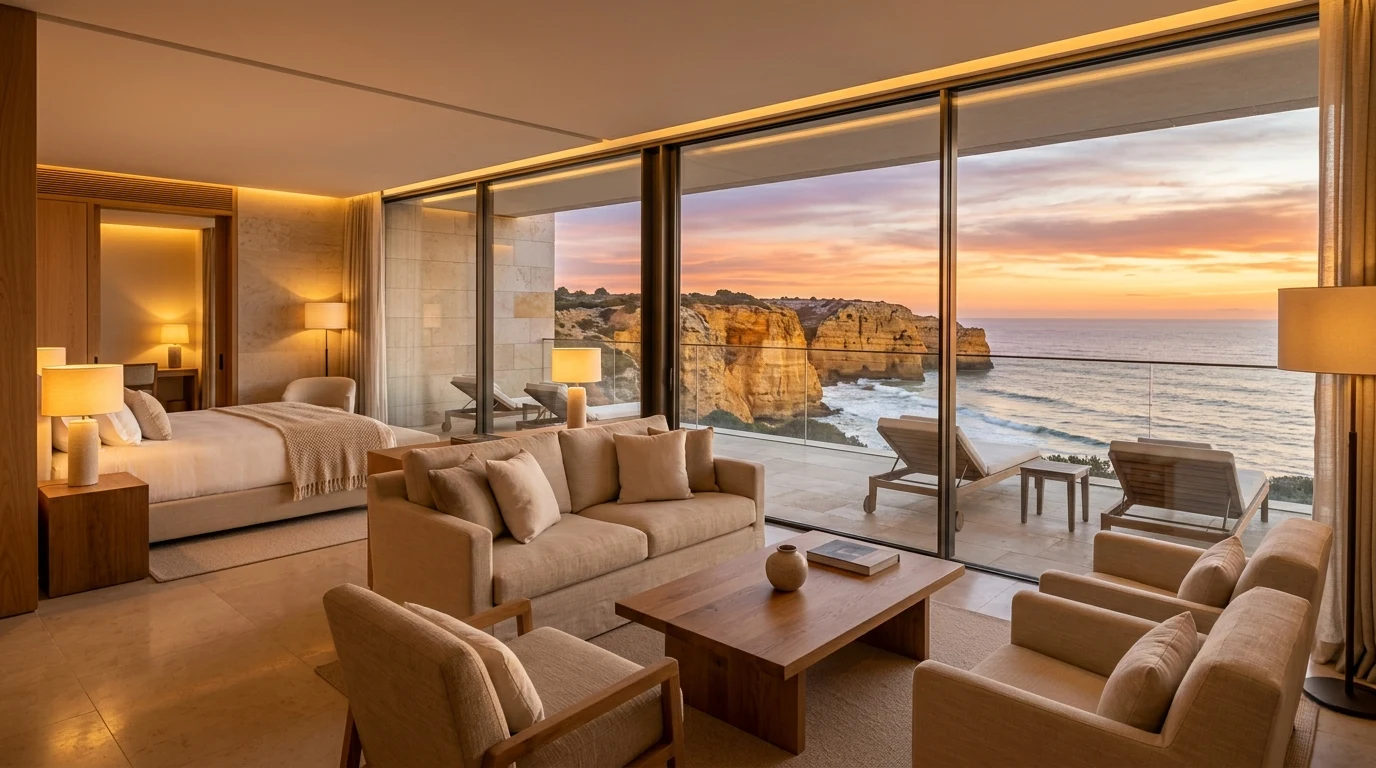
What separates a luxury resort in the Algarve from a good four-star hotel is not the pool or the view — both are abundant in the region. It is what happens inside the suite when the guest closes the door: the temperature of the light at sunset, the weight of the bed linen, the texture of the limestone in the bathroom, the absence of sound between the room and the corridor.
This article analyses the interior design decisions that define that difference — the ones the international luxury guest recognises without being able to name them.
The Algarve as a design context: what the place demands
The Algarve has a specific visual identity: the white, intense Atlantic light; the cliffs in tones of ochre and terracotta; the limestone that appears in floors, walls and construction details since the 16th century; the azulejo tile of Moorish tradition that persists in historic facades and interiors.
The luxury resorts that work best in the Algarve are those that establish a genuine dialogue with that context — not as folkloric decoration, but as structural language. Pine Cliffs uses azulejo floors and ceramic details that reference the Moorish tradition without imitating it. EPIC SANA responds to intense light with clean-lined facades and interiors in sand and sea tones that do not compete with the landscape. Martinhal Sagres uses local timber and stone as construction materials, not ornament.
The most common error in luxury resort design in the Algarve: importing a generic Mediterranean resort aesthetic — white, blue, Italian marble, catalogue European furniture — that could be in Crete, Mallorca or Santorini. The guest who travels through twenty resorts a year notices the difference. The guest visiting the Algarve for the first time feels it without knowing why.
The suite: six decisions the guest will remember
The terrace as extension of the room, not access to the exterior. In the Algarve, the terrace is the most valuable space of the suite for approximately seven months of the year. A resort that treats it as a concrete platform with two plastic chairs is wasting its most expensive asset. The terrace must have local stone flooring or treated timber decking, high-density contract furniture (minimum 30,000 martindale), adjustable shading — awning or pergola — and low-intensity lighting for the evening period.
Natural light managed, not left to chance. Algarve light is white and intense — at two in the afternoon in August, without management, it is unbearable in an interior. Solar protection must be double: exterior (louvre, brise-soleil or awning) to reduce thermal load, and interior (opaque linen curtain with recessed track) for environment control. The system that works best: motorised exterior blind for temperature management; interior curtain with natural fall for light and privacy control. The two systems are independent.
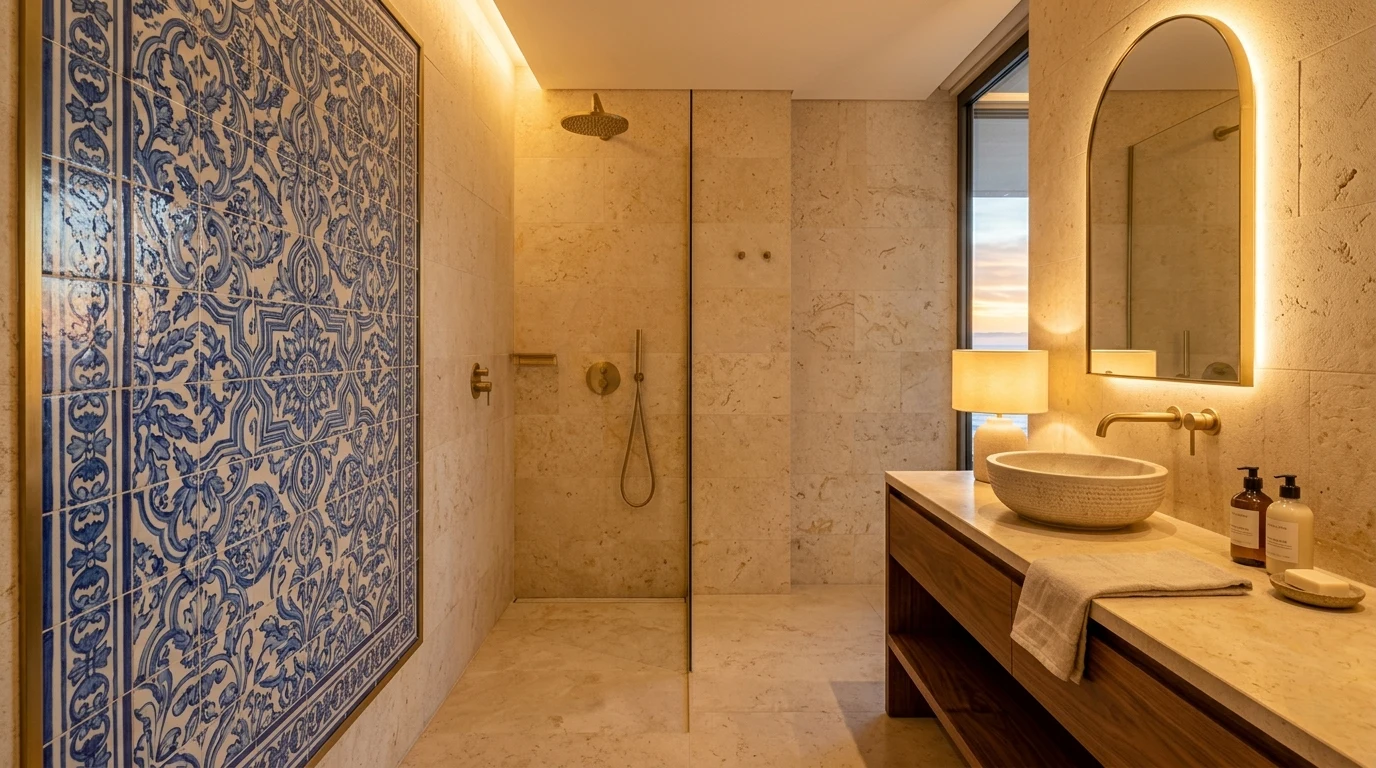
The bathroom with Algarvian identity. Local limestone, Algarve yellow stone or Borba marble — regional, recognisable materials — have a coherence with context that imported Carrara marble does not. In a luxury resort bathroom in the Algarve, regional stone on floor and countertop (with adequate waterproofing) is an aesthetic decision with geographic argument. Artisan azulejo on shower walls — of Portuguese production, not import — serves the same function: the suite tells the guest where they are.
Sound — or the absence of it. The luxury guest who rates a resort negatively rarely uses the word "acoustics". They say "corridor noise", "heard the neighbours", "didn't sleep well". Acoustic isolation between suites and between suite and corridor is a technical construction decision that interior design cannot solve retrospectively but can aggravate. Corridor carpet, door seals, mineral wool in suspended ceilings — these are measures the interiors project must specify or verify.
The bed as the centre of the space, not as furniture. In a luxury resort in the Algarve with seven to eight months' occupancy, the bed undergoes use intensity equivalent to twenty years in a private residence. The base must be metal or solid timber structure — never particleboard — the mattress pocketed spring with a high-density latex or memory foam layer, the bed linen washed linen (not standard percale cotton) that improves with washing.
Lighting colour temperature at sunset. The Algarve has golden-hour sunsets of intense quality — a landscape asset. Interior artificial lighting should compete as little as possible with that light: 2,700K on all interior circuits, dimmable independently by zone (bedside, sitting area, bathroom). When the guest steps in from the terrace at dusk, the light transition should not be a shock.
The infinity pool and water zones: design that photography doesn't capture
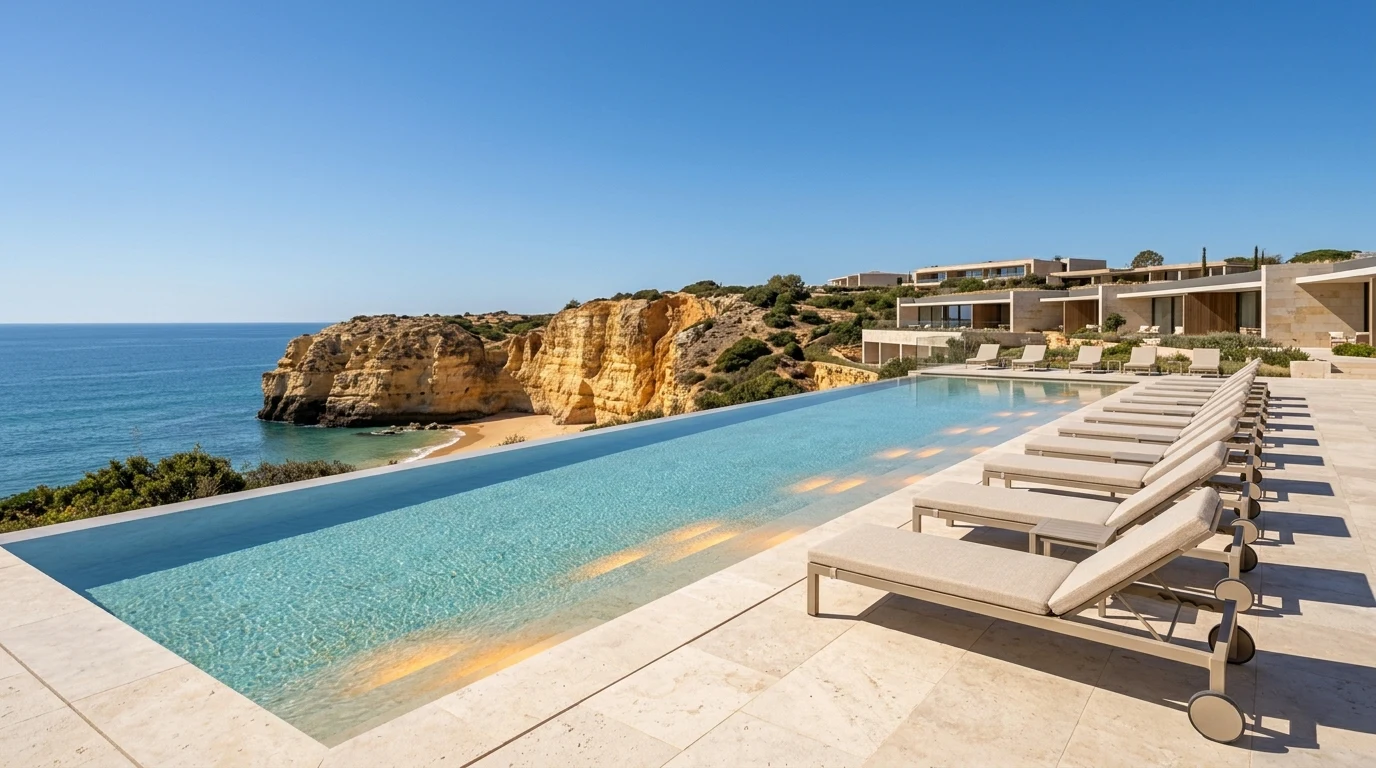
The infinity pool with Atlantic horizon is the most published image of luxury resorts in the Algarve. It is also the space where design decisions have the greatest impact on the real guest experience — which differs from the photograph.
What the photograph does not show: the temperature of the surrounding pavement at two in the afternoon (dark stone in August can reach 60°C at the surface); the light reflection on the water surface that makes comfortable conversation impossible from eleven in the morning; the acoustics of the bar zone distributing sound unevenly; the quality of outdoor furniture that after two years of Atlantic exposure looks three-star.
Design criteria for luxury Algarve resort pool zones: Paving — light-coloured travertine or fine-grain limestone with textured (not polished) finish that does not absorb heat and is non-slip when wet. Local stone in beige or cream simultaneously resolves aesthetics and functionality. Outdoor furniture — thick-gauge powder-coated aluminium (minimum 2mm) with high-tenacity synthetic fabric (UV and salt-resistant), or certified-origin teak with annual treatment. Never resin or polypropylene at a five-star resort. Shading — HDPE shade sails with tension system, or aluminium pergolas with adjustable louvres. The conventional parasol limits horizon visibility and creates visual asymmetries. Pool lighting — underwater at 2,700K or 3,000K, never blue or cold white, with intensity control for the evening period.
The terrace at sunset: the moment that decides the review
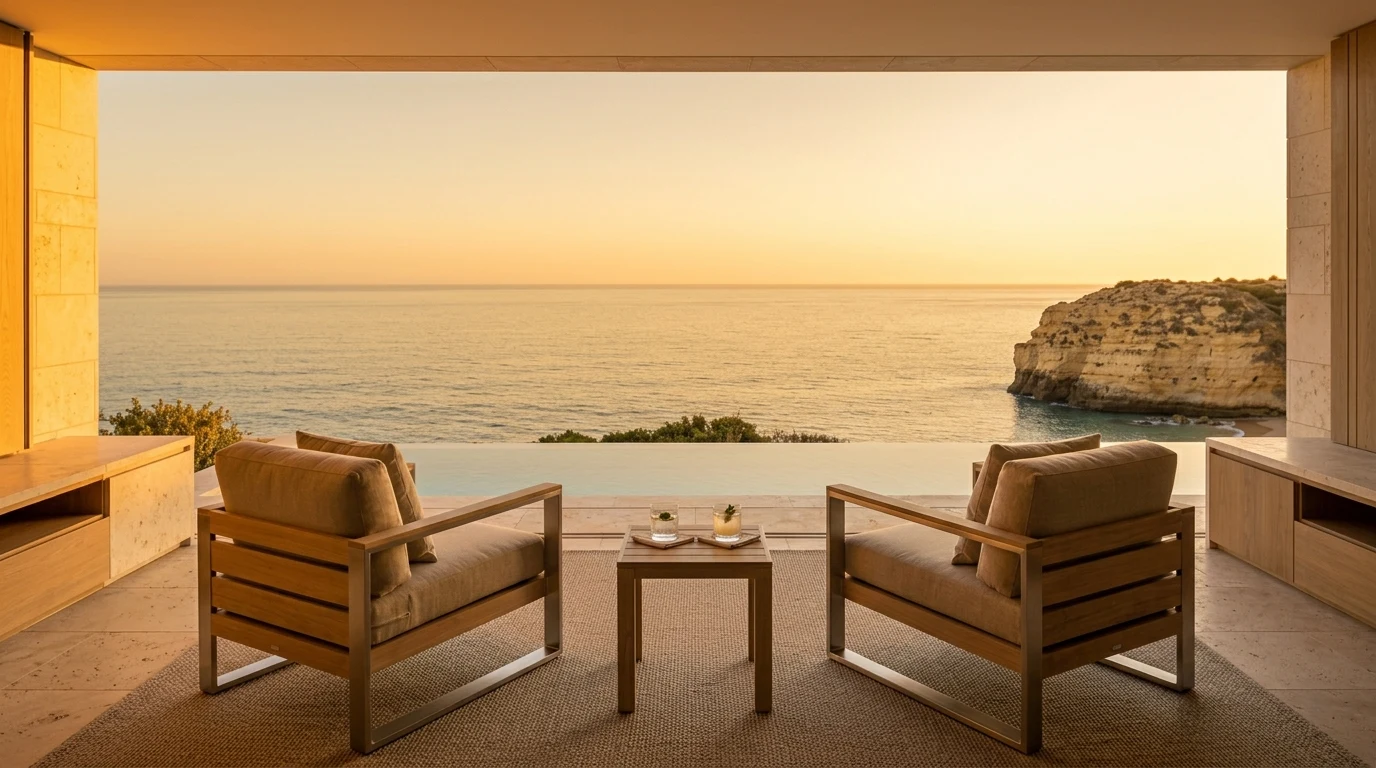
The guest who books a view suite in the Algarve in August pays the rate difference for one specific moment: the sunset on the terrace with the Atlantic behind them. That moment — lasting between twenty minutes and an hour — is the experience peak on which the resort review, the social media share and the decision to return will depend.
The terrace that supports that moment has: two armchairs — never garden chairs without armrests, which are uncomfortable beyond fifteen minutes — a small table that allows setting down a drink or a book without standing up, low-intensity lighting that at dusk does not compete with natural light and at night creates atmosphere without glare, and an unobstructed view of the horizon from the seated position.
That last point — the horizon view from a seated position — is frequently overlooked in the project. The terrace parapet is dimensioned for standing height. When the guest sits, the view is cut by the parapet, railing or low wall. Resolving this in the project costs nothing. Resolving it after construction is impossible.
The dining space: where the Algarve's identity should be most present
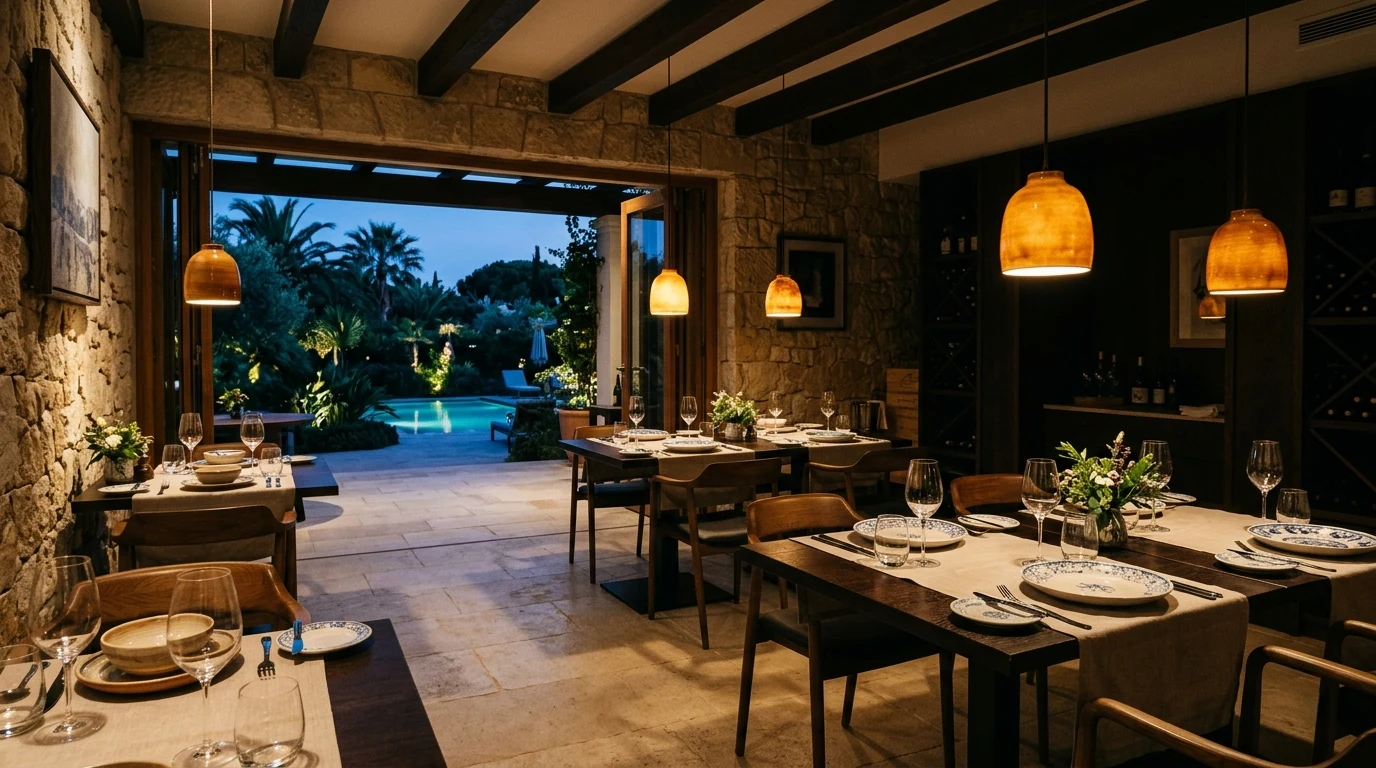
The restaurant of a luxury resort in the Algarve is the space where the international guest spends the most time with open eyes and available attention. It is also the space where the identity of the place must be most articulated — not as themed decoration, but as material and sensorial coherence.
The resorts that handle this best use the dining space as a territorial manifesto: local limestone on floors and countertops, artisan Portuguese azulejo on wall panels, olive or carob timber in furniture and lighting details, Porches or São Pedro do Corval ceramics in tableware. These materials are not more expensive than their imported alternatives: they are choices that require research and intention.
Dining space lighting follows the same criteria as any luxury hospitality context: 2,700K over the table, minimum CRI 95 so grilled fish and white wine maintain their true colour, pendant luminaire as visual protagonist and narrative argument, contrast between lit table and dim background that creates intimacy without darkening the space.
One frequently underestimated decision: the visual opening between the restaurant and the exterior. In the Algarve, for seven to eight months of the year, dining with a direct view of the garden and pool is part of the product. A design that separates interior from exterior with an opaque wall — for climate control or noise reasons — eliminates half the gastronomic argument of the resort.
How much does interior design cost for a luxury resort in the Algarve?
Interior design costs for a luxury resort in the Algarve — including project, FF&E specification and installation direction — typically range from €35,000 to €90,000 per suite or accommodation unit, depending on the level of customisation and materials chosen. For common areas — lobby, restaurant, spa, pool and access zones — the cost per square metre generally falls between €800 and €2,500, depending on project complexity and finishes.
The design chapter represents between 8% and 15% of the total construction or renovation budget. In a mid-sized resort renovation — 60 to 100 accommodation units, common areas included — the interior design budget typically sits between €2.5 and €6 million.
The relevant data point for the developer or investor: luxury resorts in the Algarve with well-documented interior design coherent with the regional context systematically achieve higher ratings on booking platforms — which translates directly into a higher average rate and more stable occupancy. The rate difference between a well-located four-star resort and a five-star with differentiated interior design in the same territory can reach 60-80% per night. Design is not a cost: it is a revenue lever.
What the Algarve's 2026 international luxury guest already knows they want
The luxury guest profile in the Algarve has changed in the last decade. The British golf tourist who books six months in advance now coexists with the long-haul traveller — North American, Scandinavian, from the Gulf — who chooses the Algarve as a luxury destination by comparing it with the Alentejo, the Amalfi Coast or southern Spain.
That guest already knows what they want before arriving. They have read the reviews, seen the photographs, compared the suite videos. And when they arrive, they verify whether what is in front of them corresponds to what they felt online. Interior design is what guarantees — or destroys — that correspondence.
The resorts and boutique hotels in Portugal that have grown in international reputation share one characteristic: interior design is a strategic decision, not a residual budget line. Véline Interiors works with hotel developers and investors in the Algarve and across Portugal to develop interior design projects that convert location into destination.
Véline Interiors · Hospitality Design
Want design to decide the guest experience before they arrive?
We work with hotel developers and investors in the Algarve to convert location into destination.
Present your project →