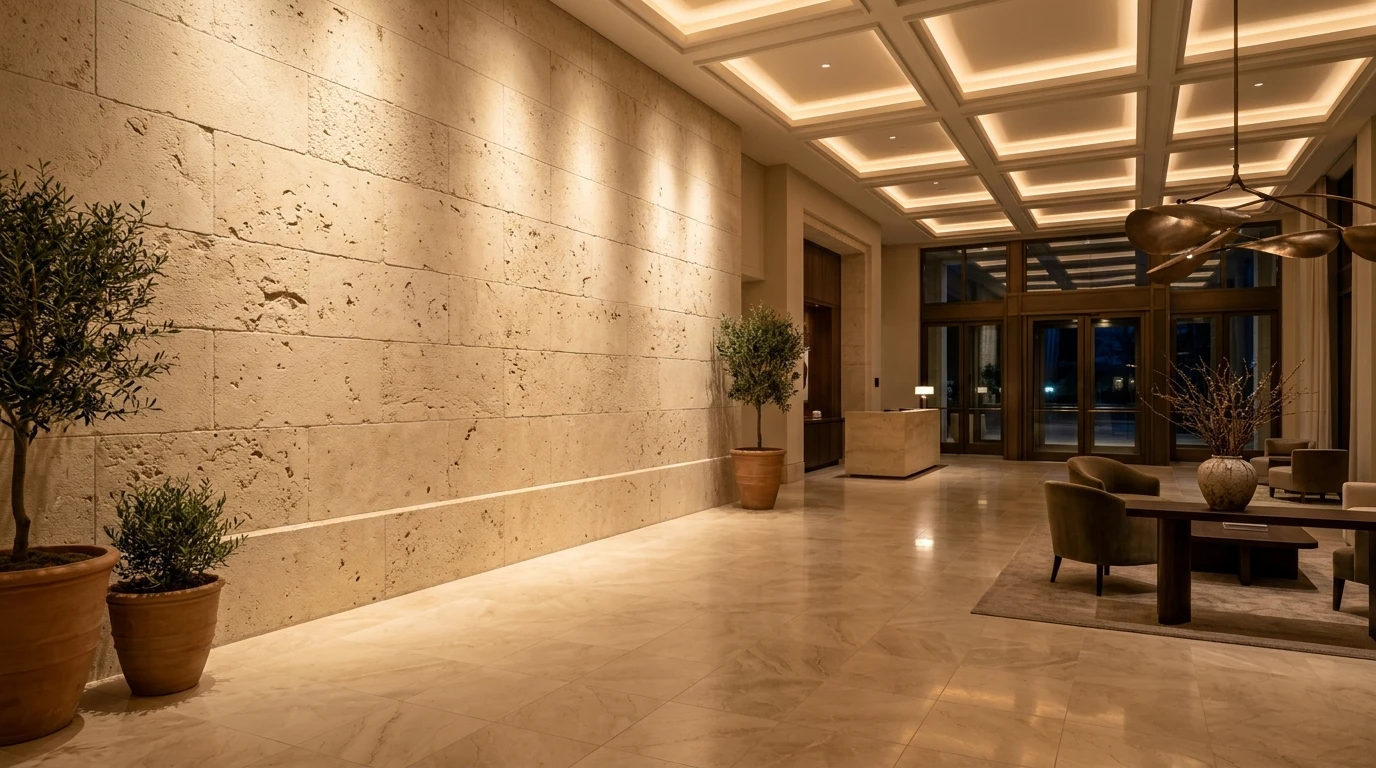
Wall cladding in a twenty-room boutique hotel can represent an investment of between €80,000 and €300,000 depending on the material. If that material lacks the abrasion resistance, maintenance ease and durability appropriate to the zone where it is installed, it degrades in three to five years and forces a partial renovation costing almost as much as the original investment.
The prior criterion: traffic zone defines material, not the other way around
The most common starting error in hotel interior design projects: choosing the material by aesthetic criterion and then verifying whether it will withstand use. The correct sequence is the reverse. First classify the zone by use intensity and environmental conditions, then choose among the materials that meet those requirements.
The standard classification in hospitality has four categories: very high traffic and contact zones (corridors, lobby, lifts, stairs); high traffic with humidity (common area bathrooms, spa changing rooms, pool surrounds); medium traffic (bedrooms, suites, dining rooms); low traffic (private rooms, meditation spaces, offices). Each category has a range of compatible materials and a range of unsuitable ones. Polished marble in a 200-room hotel corridor is unsuitable: it scratches within weeks. Unsealed clay in a common area bathroom is unsuitable: it absorbs humidity and degrades. Standard wallpaper in a heavily used corridor is unsuitable: it deteriorates in months.
Natural stone: the longest-lasting and heaviest cladding
Natural stone — granite, limestone, marble, travertine — is the longest-lasting wall cladding in hospitality. Well executed, it exceeds fifty years without significant visual degradation. Its main limitation is not technical: it is structural. A 20mm marble slab weighs between 50 and 60 kg/m². In historic buildings or upper floors, that load may be structurally unviable without reinforcement.
Flexible stone panels — natural stone in 2-3mm laminate bonded to fibre-glass backing, weighing 3-5 kg/m² — have gained significant market share in recent years, preserving the appearance and texture of solid stone at a fraction of the weight and installation cost. In hotel renovation projects in existing buildings in Portugal, this system has reduced installation times by approximately 40%.
The finish matters as much as the material. Polished marble is unsuitable in corridors due to scratch sensitivity. The same marble in honed or aged finish is significantly more resistant to intensive use. Matt limestone is the most robust choice for hotel corridors: sufficient hardness, minimal maintenance and aesthetic coherence with contemporary neoclassical interiors. Indicative installed cost: Portuguese limestone (Moleanos, Alpinina) dry-mounted, €180-350/m². Carrara marble or imported equivalent, €300-600/m². Flexible stone panels, €90-180/m² including installation.
Timber: the warmest and most maintenance-demanding cladding
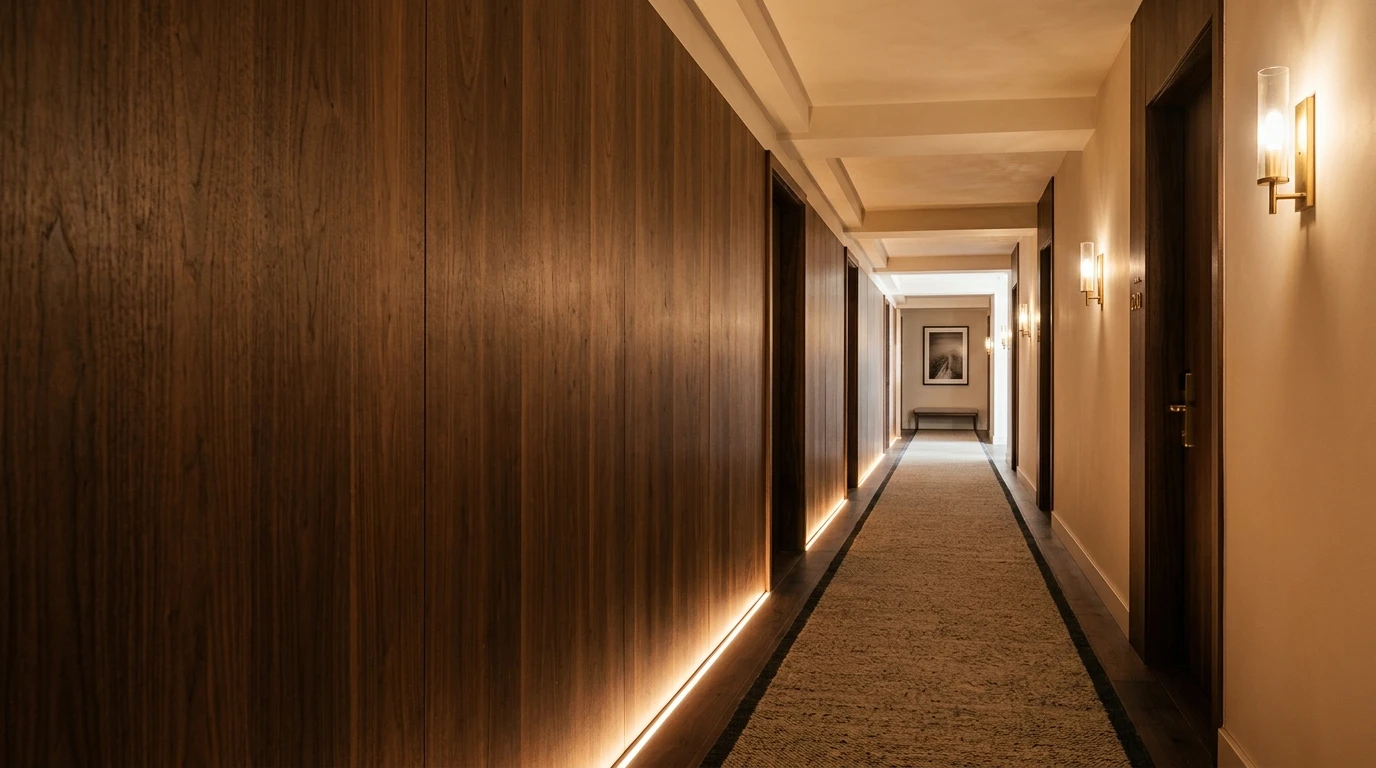
Timber as wall cladding in hospitality produces a sensory impact that no other material delivers: tactile warmth, acoustic reduction and natural aroma. Technical criteria for hotel wall timber: minimum 12mm thickness in solid board, oil finish rather than varnish (varnish cracks with use and requires complete sanding for repair; oil allows spot touch-ups), Janka hardness above 1,200 for contact zones (European oak: 1,290; walnut: 1,010 — borderline; pine: 870 — unsuitable in a thoroughfare wall). Timber with visible natural grain and matt finish ages best visually: scratches and use marks integrate as patina rather than standing out as defects.
Clay and lime plaster: luxury contemporary interiorism's claddings
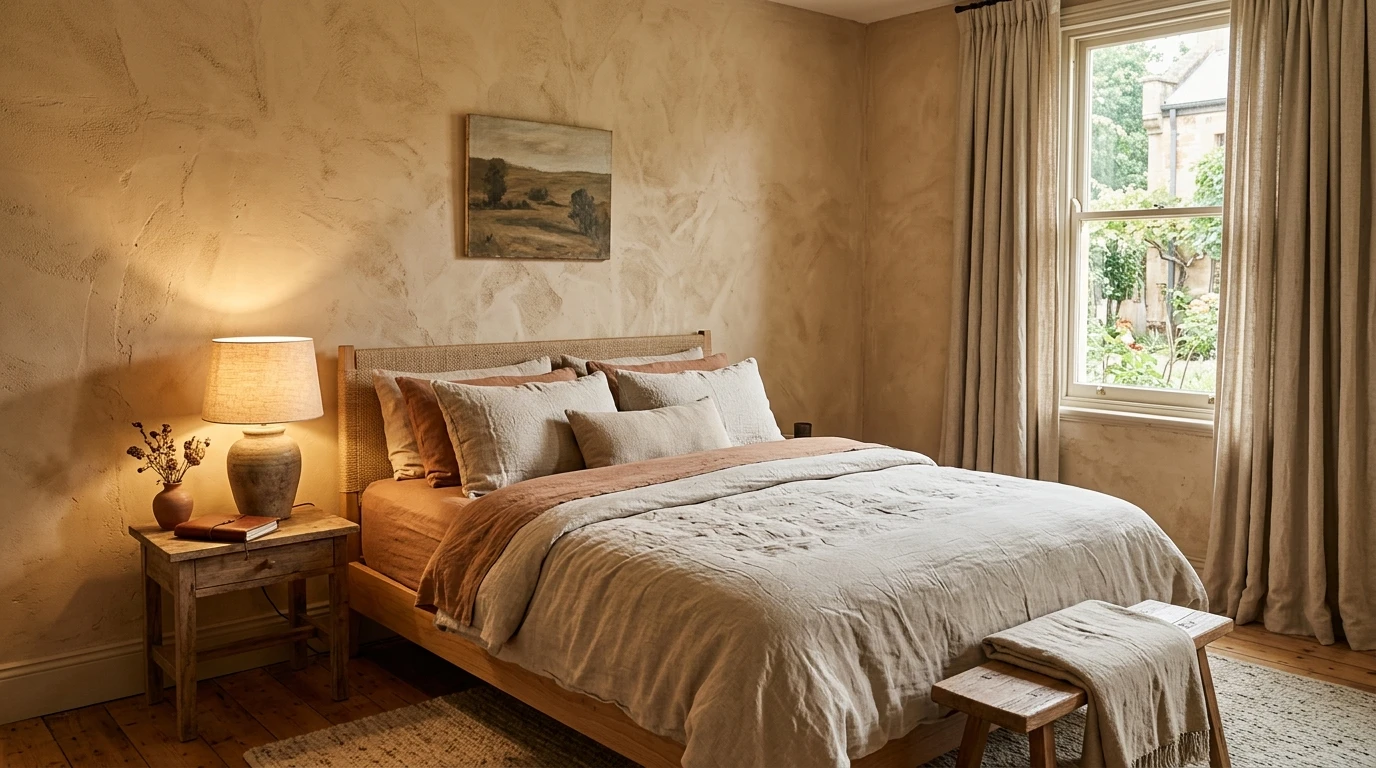
Lime plaster (intonachino, marmorino) is the most versatile for hospitality: applicable in 2-5mm thicknesses over any structurally stable substrate, accepts mass pigmentation for a broad palette, and with a microcrystalline wax or silicone topcoat can be used in wet areas such as bathrooms or spas. Its abrasion resistance is medium: suitable for bedrooms and low-traffic zones, not for high-use corridors without additional sealing.
Pure clay (clay plaster, raw earth) is more sensitive to humidity and impact than lime plaster, but produces greater visual depth and more effective hygroscopic regulation of the ambient environment. In meditation rooms, wellness suites and spa zones where air quality and the absence of synthetic compounds is an argument, clay is the reference cladding. Indicative cost: €45-120/m² depending on finish and applicator.
Artisan azulejo: the identity cladding
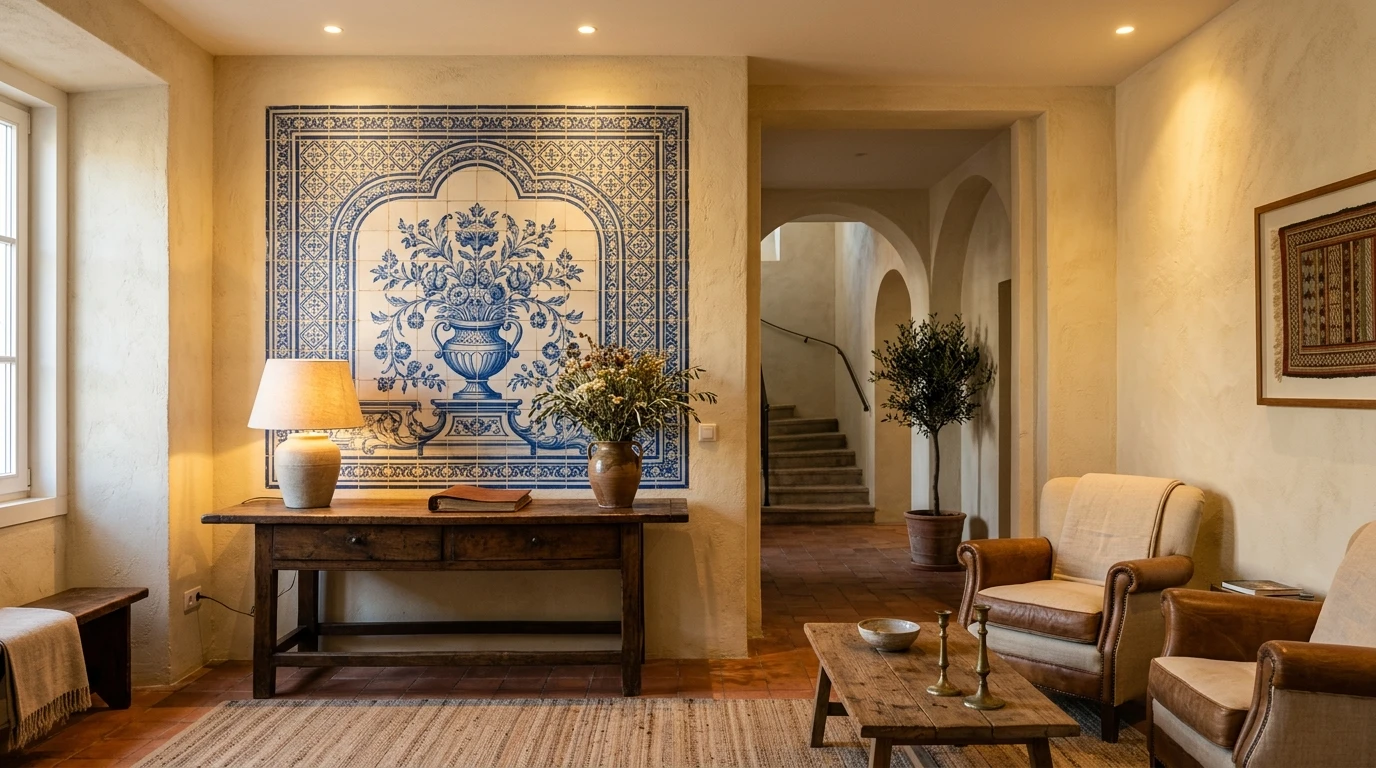
Artisan azulejo — Portuguese, Spanish or Moroccan production, high-fired, with hand-applied glaze — is not merely a cladding: it is a place identity argument. In hotels in Lisbon, Porto, Seville or Valencia, artisan azulejo as a focal element in the lobby, restaurant or bathrooms anchors the guest to the territory from first visual contact.
Technical criteria: minimum surface hardness of 6 on the Mohs scale for high-traffic zones, water absorption below 3% for wet areas, minimum 3mm joint sealed with epoxy mortar in pool or spa zones. The most versatile contemporary hospitality format: 15×15cm or 20×20cm as a focal mural panel, combined with lime plaster on adjacent walls. That combination — artisan azulejo as punctual protagonist, plaster as background — avoids the visual saturation of all-over tile and significantly reduces the overall cost per square metre. Cost of Portuguese or Spanish artisan azulejo: €60-180/m² depending on producer and design complexity.
Contract wallpaper and textile: bedroom claddings
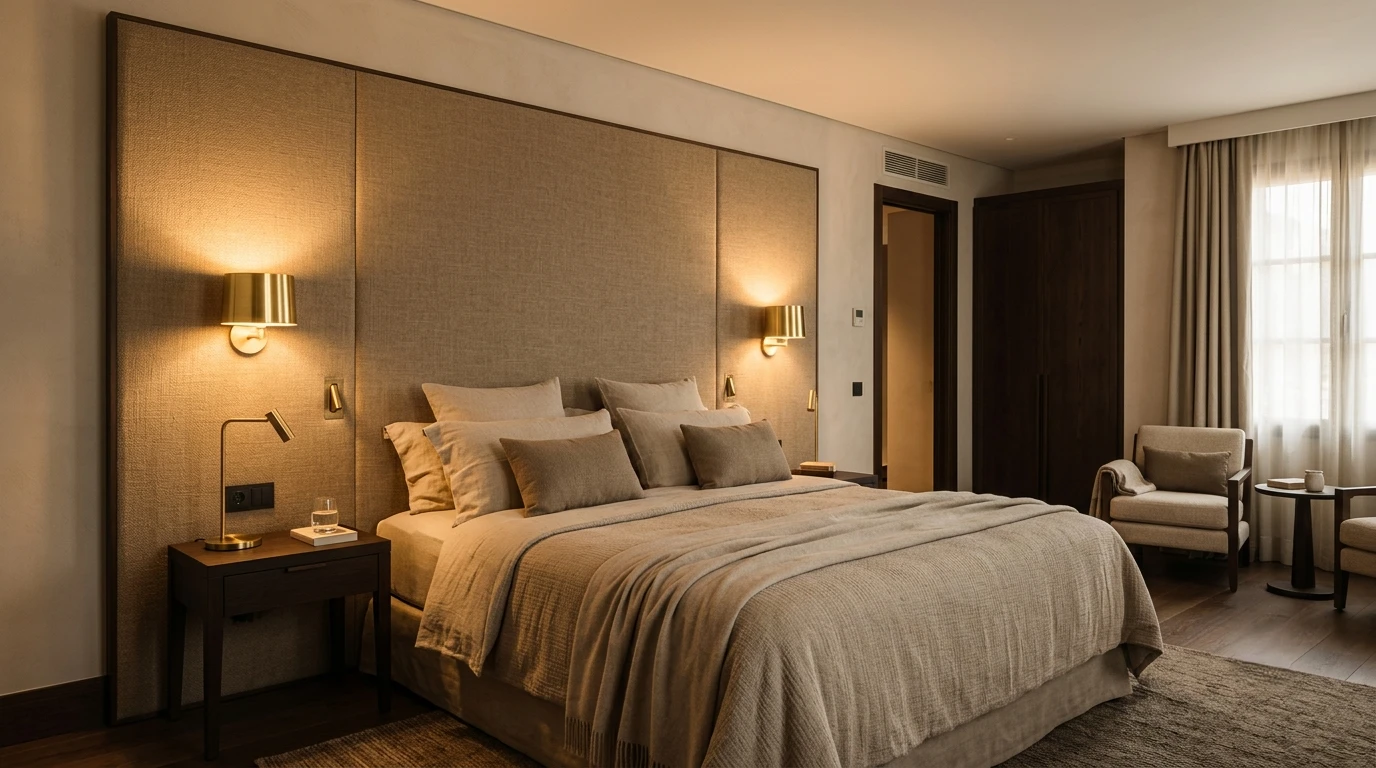
Contract technical wallpaper — type IV vinyl or fibreglass-backed — is the most common cladding in four- and five-star hotel bedrooms for three reasons: fast installation, easy replacement and significantly lower cost per square metre than the materials above. In the five-star boutique segment, however, standard wallpaper is being displaced by two alternatives with better value perception.
Tensioned textile — linen, wool or velvet mounted on aluminium frame over the wall — produces a visual depth and tactile warmth that paper does not achieve. Its operational advantage in hospitality: the tensioned panel demounts in minutes for washing or replacement without damaging the underlying wall. Exclusive design wallpaper — digital print on fibreglass backing, with designs developed specifically for the project — is the intermediate alternative: lower cost than tensioned textile but with visual identity the standard catalogue cannot provide.
The economic decision: initial cost vs life-cycle cost
Cost comparison between wall claddings in hospitality must be made over the material's life cycle, not its initial installation cost. A quality contract wallpaper at €35/m² installed requires replacement every eight years in intensive hotel use: the real cost over twenty years is €87.50/m². Portuguese limestone at €200/m² installed requires no replacement over twenty years: the real cost over twenty years is €200/m².
Interior design for boutique hotels and luxury villas in Spain and Portugal includes complete wall cladding specification as part of the project. If you have a project in development and want to evaluate the correct materials for each zone, the conversation is open.
Véline Interiors · Hospitality Design
Have a project in development?
We specify the right claddings for each zone, with technical and design criteria.
Present your project →