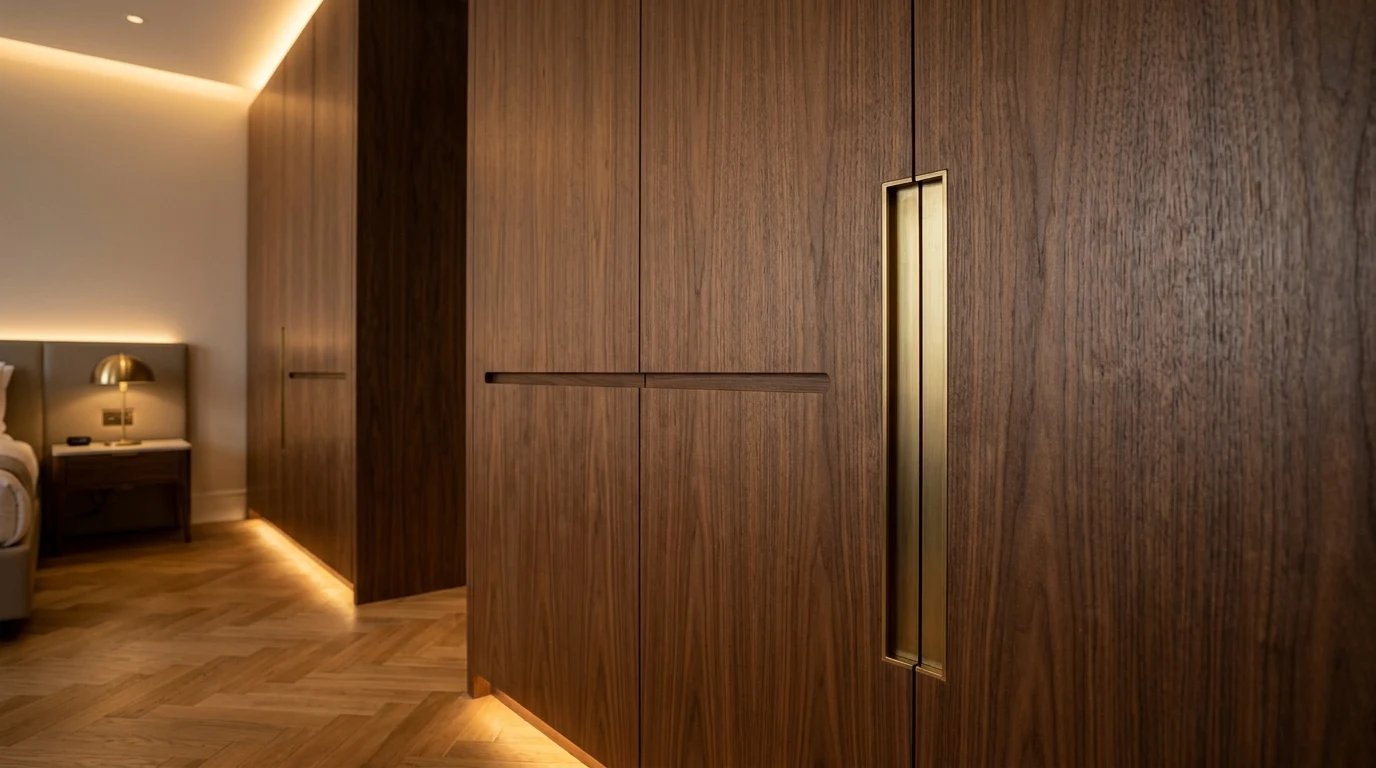
Catalogue joinery — standard particleboard modules with timber veneer or lacquer, zamak chrome handles, plastic hinges — is the element that most frequently betrays the difference between a hotel that has invested in surface design and one that has invested in detail design. It can be painted in the correct colours, placed in the correct proportions and photographed with the correct lighting, and still produce in the guest who touches it the sensation of mass-market product in a context that promised something else.
This article examines what makes bespoke joinery in luxury hospitality worth its cost, which timbers and finishes produce the best results, and which details make the difference.
The timber: species, cut and finish as design decisions
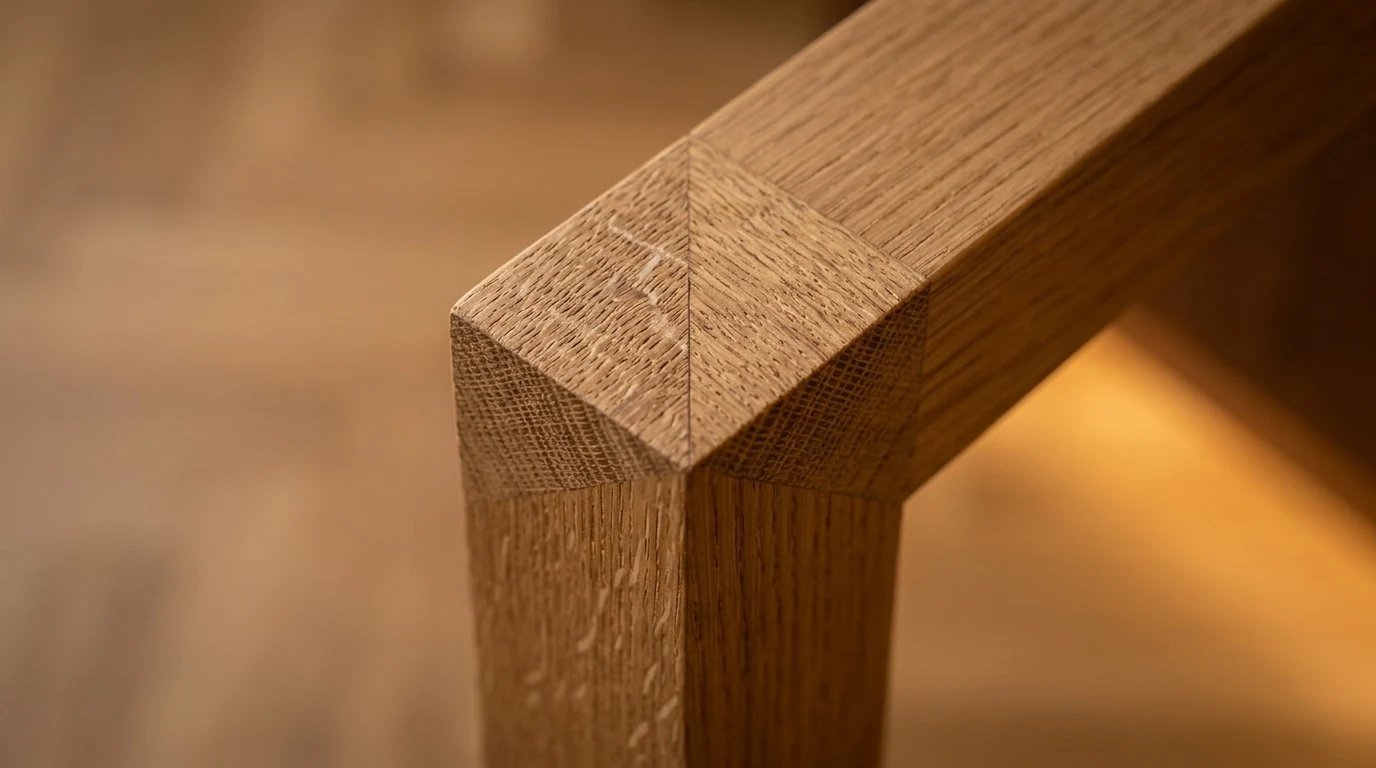
The timber species is the first design decision in bespoke joinery for luxury hospitality, and the one that most directly defines the space's register. Oak — in its American (Quercus alba) and European (Quercus petraea) variants — is the most widely used timber in luxury interiorism projects in Spain and Portugal for its balance of price, durability and register versatility: European oak quarter-sawn with the medullary ray visible produces a more classic and warmer register; American oak flat-sawn with a looser grain produces a more contemporary register. The cost of first-quality oak panel or veneer ranges between €80 and €160 per m² of fabricated material, depending on origin and thickness.
Walnut — American (Juglans nigra) or European (Juglans regia) — is the timber of greatest perceived luxury in five-star hospitality projects. Its deep grain in chocolate, caramel and black tones produces a visual richness that oak does not reach, and its greater density produces a heavier and warmer touch that the high-net-worth guest directly associates with quality. Walnut costs 40-60% more than oak, and its availability in wide formats — boards over 40 cm wide for seamless wardrobes without visible joints — is more limited.
The timber finish is the third variable after species and cut. Oil finish — linseed oil, tung oil, Rubio Monocoat — keeps the timber pore open and produces a touch the guest perceives as "real wood": slightly textured, without artificial sheen, with the grain texture perceptible to the touch. Beeswax finish produces a similar result with a slight warming of the tone. High-gloss two-component lacquer produces a durable, easy-maintenance surface but completely eliminates grain texture and produces a "plasticised wood" visual effect increasingly rare in luxury projects. Very low satinwood lacquer (under 10% sheen) is the only lacquer variant compatible with a luxury register.
The integrated headboard: the highest-impact joinery in the room
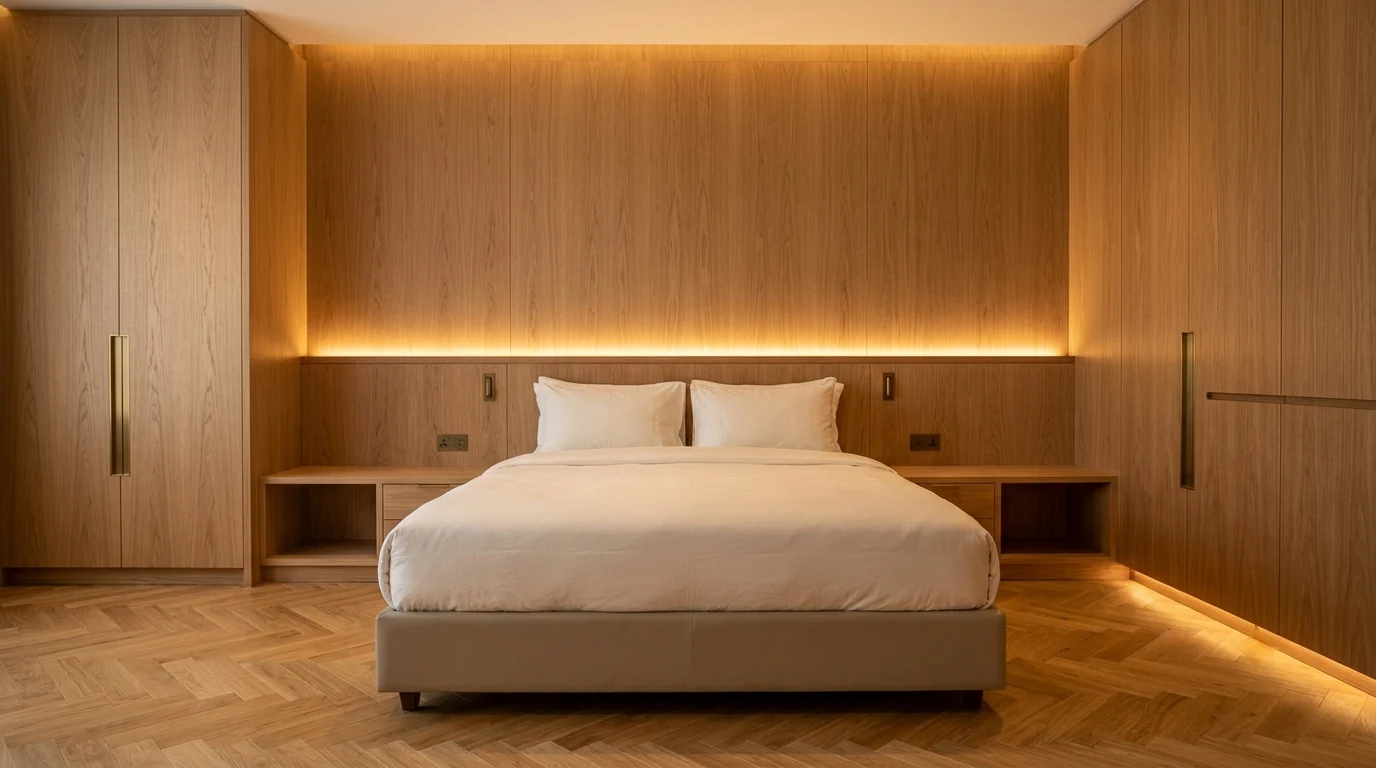
A bed headboard integrated in joinery that spans the full wall — wall to wall and floor to ceiling, or at least floor to ceiling in the central section — is the joinery element of greatest visual impact in a luxury boutique hotel bedroom. Not because it is more expensive than the wardrobe or entry console, but because it is the first element the guest sees on entering the room — it faces the entry door in most layouts — and the one that defines the space's register in the first three seconds.
An integrated headboard in oak or walnut joinery with concealed LED lighting behind a batten at 2,200K, with bedside tables integrated as extensions of the same joinery and all cables completely concealed, produces a room-as-architecture effect that a freestanding upholstered headboard cannot achieve. The continuity of the timber from floor to ceiling, with the bed floating in front of that timber background, produces the designed-as-a-whole sensation the boutique hotel guest identifies as "they have thought of everything here."
The technical details that determine whether an integrated headboard is high quality or not: the junction between the timber panel and the ceiling (it should be mitred, or have a 5-8 mm shadow gap that conceals expansion without looking like a clumsy joint), the integration of the lighting (the lighting channel must be concealed by a batten that projects light toward the wall and the bed, never a visible LED strip), and the transition between the timber panel and the bedside tables (the grain must continue so the whole reads as a single element, not three separate assembled pieces).
Handles: the tactile detail of greatest impact per cost
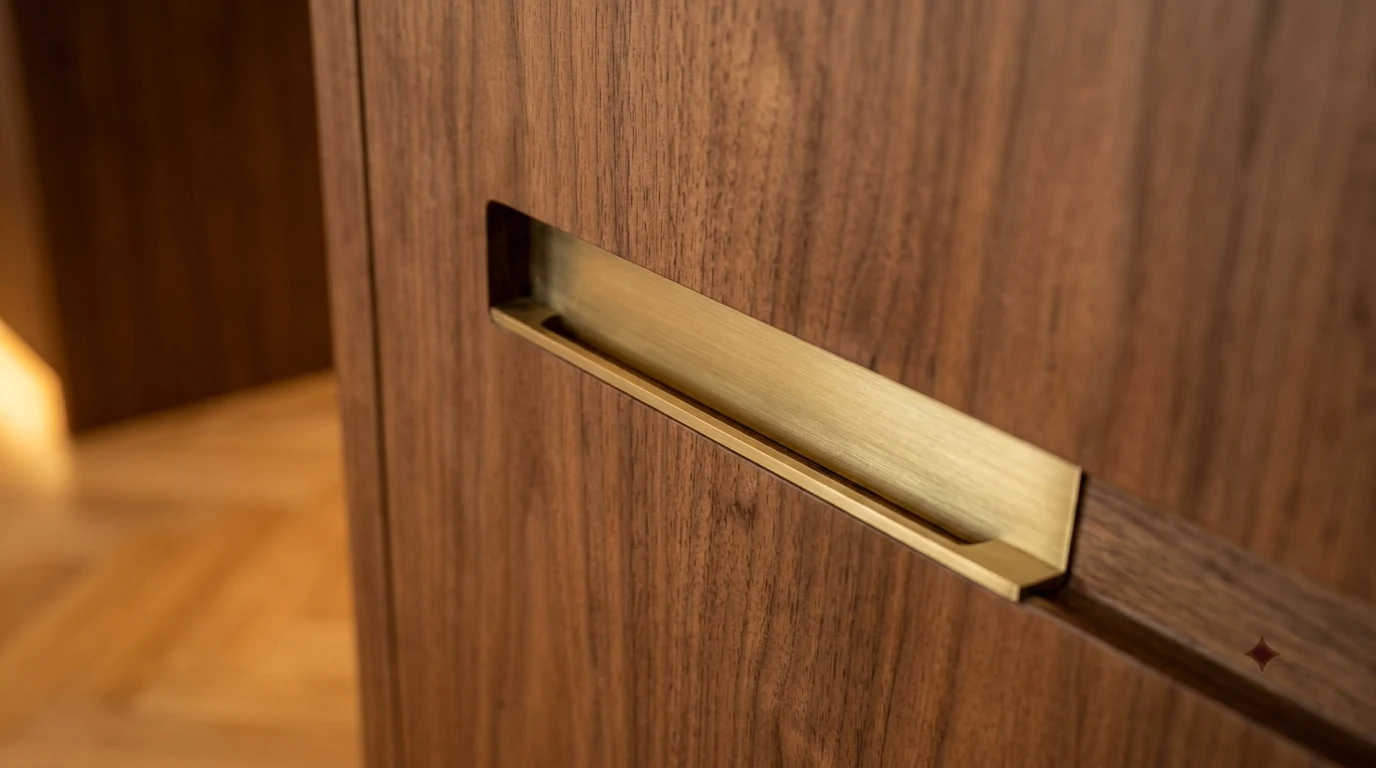
The handle is the joinery element the guest touches most times during their stay and the one that most directly communicates quality to the touch. A generic zamak or anodised aluminium handle — bought from any materials distributor at €8-15 — produces in the hand a sensation of lightness and plastic that the guest processes immediately as "cheap." A solid recessed brass handle — the channel machined into the joinery itself, with brushed brass or natural leather handle inserted — produces a sensation of weight, smoothness and precision that no catalogue handle can replicate regardless of its price.
The handle options with the best tactile and visual profile in luxury hospitality projects: a handle recessed into a channel in the joinery itself (the cleanest visual solution, requiring the channel to be designed and machined into the piece from fabrication), a solid brushed brass bar handle with circular or square section (minimum 15 mm diameter, length proportional to the door — between 150 and 400 mm —, with concealed flat-head screw fixing), and a braided or stitched leather handle with concealed brass fixing (for drawers and smaller doors, producing the greatest tactile contrast between the warmth of leather and the solidity of the timber). The budget for handles in a boutique hotel bedroom with bespoke joinery can vary between €200 (mid-quality catalogue handles) and €1,500 (bespoke solid brass or specialist manufacturer handles), on a total joinery cost that may be €15,000-25,000: the cost difference is under 8% and the impact on the guest's tactile experience is disproportionately greater.
The reception desk: the joinery of first contact
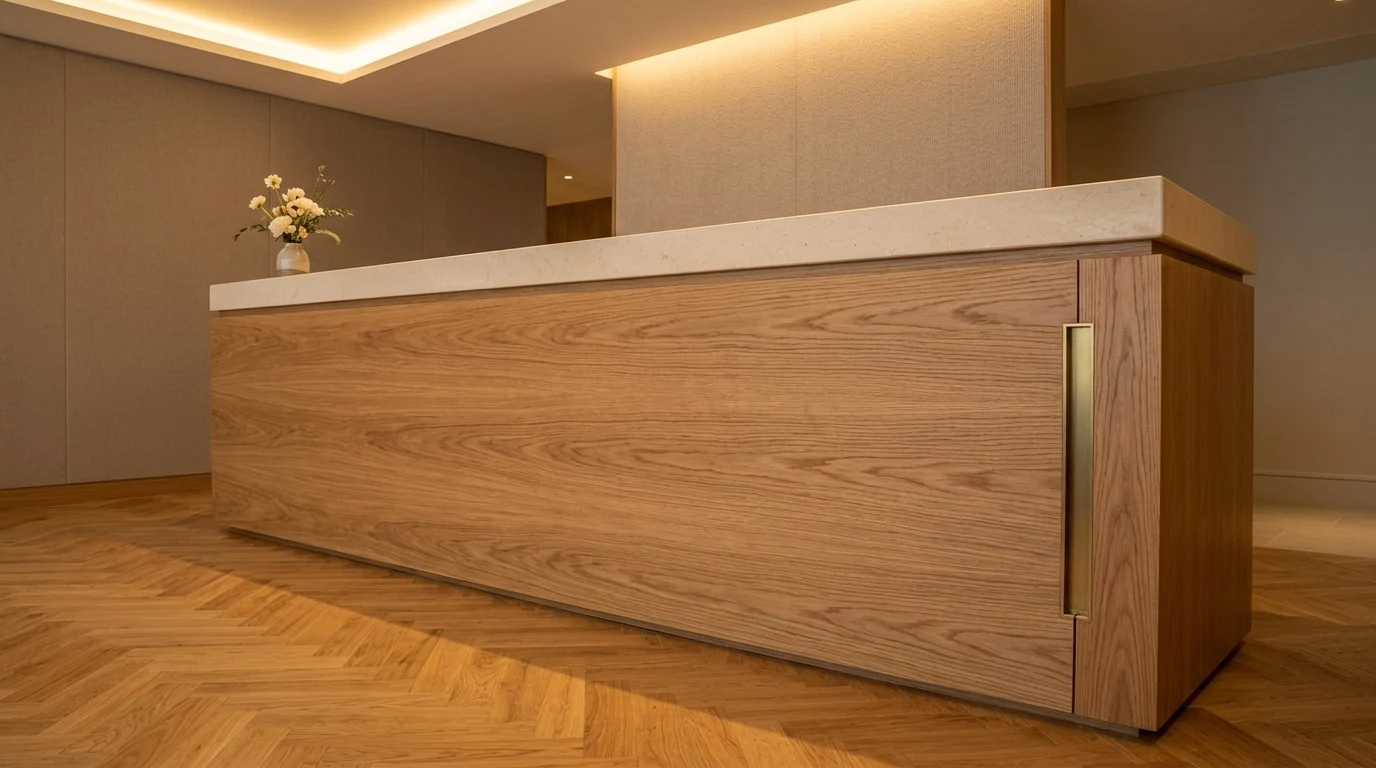
The hotel reception desk is the joinery the guest touches and sees first, and the one that most directly communicates the establishment's level before any other experience. A catalogue reception desk — melamine, aluminium trim, a visible computer on the counter — produces the first impression of an airport hotel. A bespoke reception desk in oak or walnut, with a timber front continued from floor to countertop, a natural stone countertop (limestone, marble or granite) and completely concealed technology (computer below the top, no cables visible from the guest side), produces the first impression of a designed place.
A luxury boutique hotel reception desk must meet three conditions. First, the technology must be completely invisible: no monitor, no cable, no keyboard visible from the guest side. Check-in with a tablet in hand — behind the desk or in lobby mode, with no physical counter — is the most elegant solution and the one that best communicates a contemporary boutique register. Second, the height must be correct for interaction: between 90 and 95 cm, the standing height that allows a comfortable conversation between receptionist and guest without either having to stoop or look up. Third, the countertop must have sufficient thickness to communicate solidity: a 30-50 mm stone slab on a timber front produces a sense of permanence that a 20 mm top does not achieve.
Interior design for luxury boutique hotels and villas in Spain and Portugal includes the specification and fabrication management of bespoke joinery as part of the project. If you have a project where joinery must be the differential element, the conversation is open.
Véline Interiors · Hospitality Design
Do you have a project where joinery must be the differential element?
We specify and oversee the fabrication of bespoke joinery: timbers, finishes, integrated headboards and handles.
Start your project →