For centuries this stone from southern Portugal has stood on equal footing with Carrara. The Romans already quarried the same slopes that remain in production today. And yet many Iberian hotel projects still import Italian stone out of habit, without asking whether the right answer sat two hundred kilometres away. This article is not a catalogue. It is the criteria a studio specialising in boutique hotel interior design in Portugal uses to decide when Estremoz marble is the right choice for a hotel — section by section of the building — and when to leave it out.
What Estremoz Marble Is: Varieties and Technical Behaviour
Estremoz marble is a fine-to-medium-grained calcitic metamorphic rock, quarried from the Estremoz Anticline in the Ossa-Morena zone, with quarries spread across Estremoz, Vila Viçosa and Borba. It is the only formation of its kind in the region in continuous production since Antiquity.
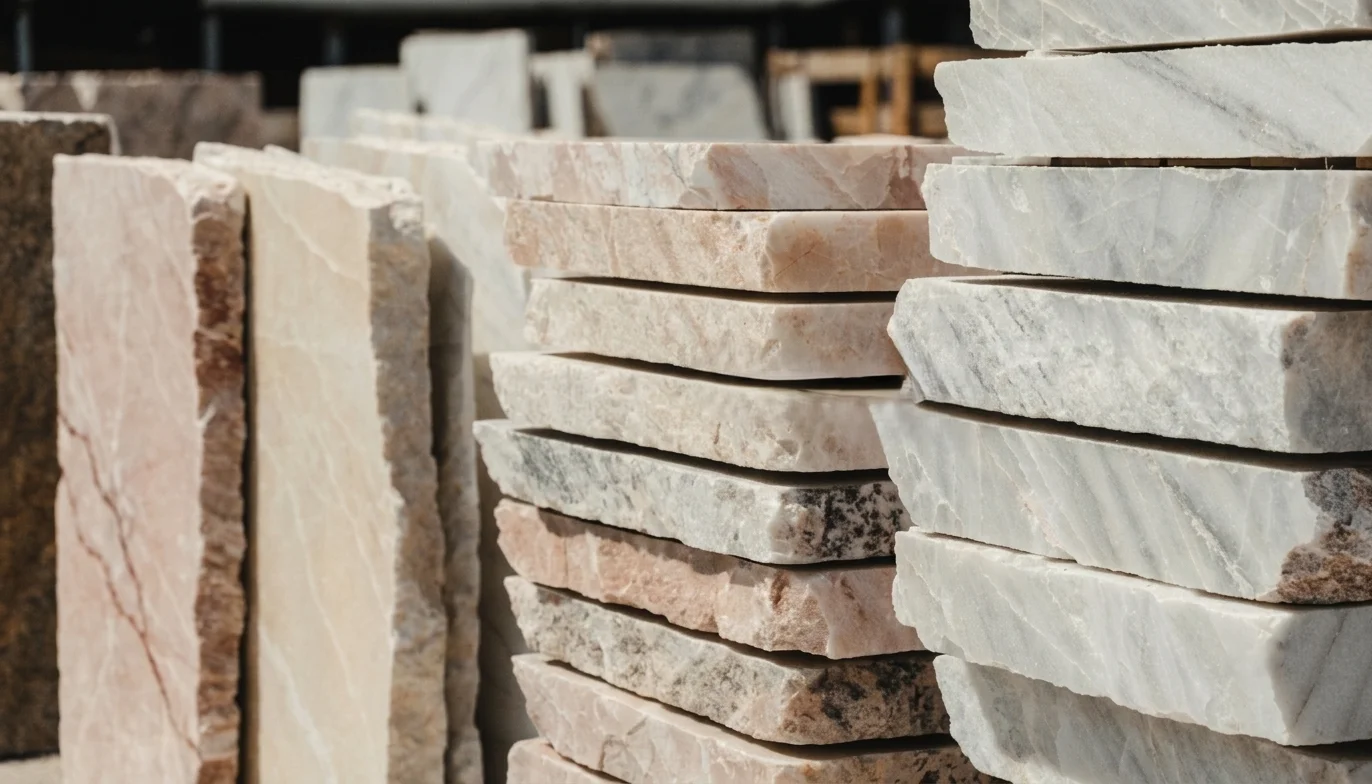
Its value to a project begins with the palette. The stone comes in several colour families: the branco, almost veinless, crystalline, the one that made the region famous; the warm, versatile creme; the rose, the rarest and most internationally prized variety, with a discreet grey-red veining; and stronger characters such as pele de tigre or ruivina. Choosing between them is not taste — it is how much presence the project wants and how much light the space has.
Technical behaviour underpins that choice. According to technical sheets tested to European (EN) standards, Branco de Estremoz shows a flexural strength of around 15.9 MPa, water absorption at atmospheric pressure of roughly 0.1%, a density near 2,710 kg/m³ and fire reaction class A1 to EN 13501-1. On site this means a dense, low-porosity, stable stone — suitable for cladding and, with the right finish, for flooring.
One precision that half the internet gets wrong: the Global Heritage Stone Resource status is granted by the IUGS, not by UNESCO's Intangible Heritage list. That 2017 UNESCO title belongs to the Bonecos de Estremoz, the clay figurines from the same town — not the marble. Two distinct heritages from one place. Citing them correctly is part of the criteria.
Where It Works in a Hotel — and Where It's a Mistake
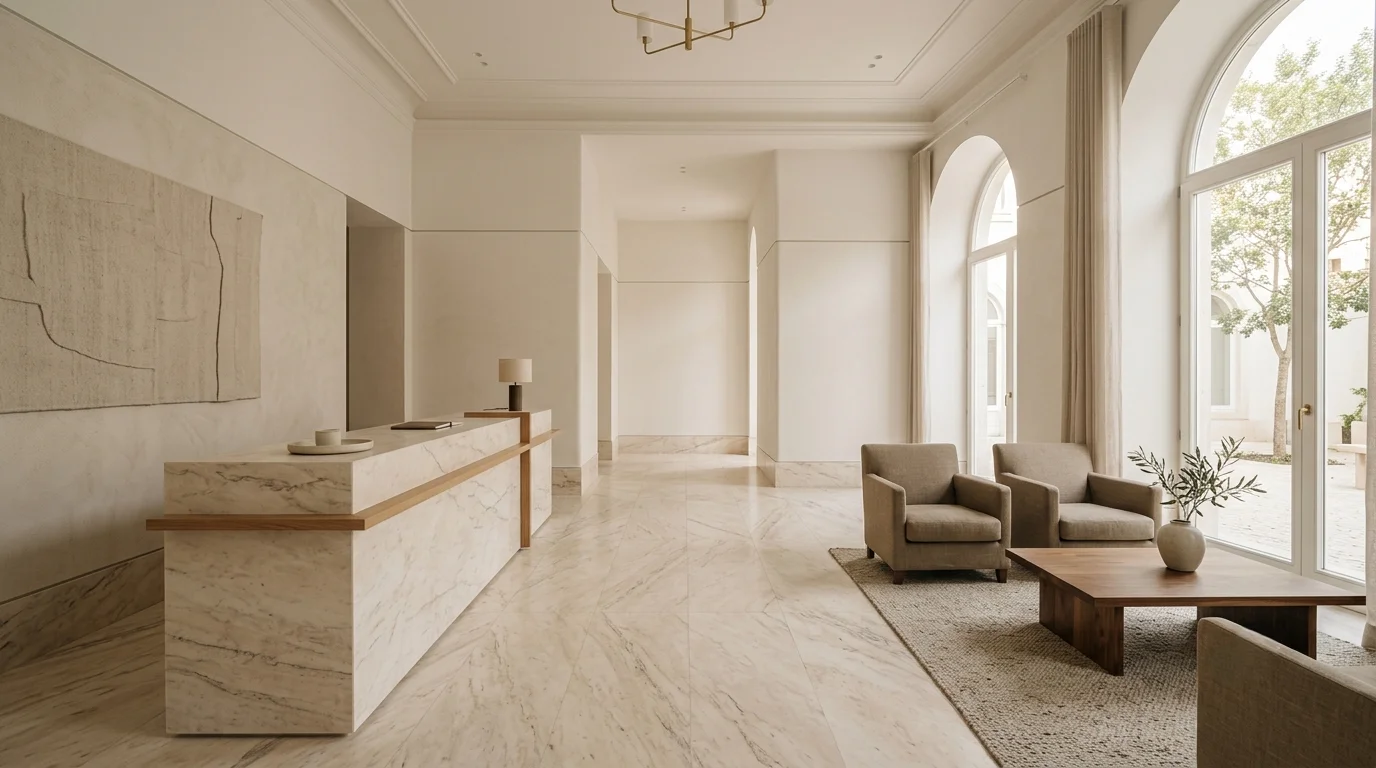
The lobby is its natural ground. It is the surface a guest crosses before deciding what they think of the hotel, and the stone works that first impression without underlining it. A solid reception desk, the foot of a staircase, a large-format floor: the stone brings continuity and weight. In the lobby the mistake is not using Estremoz — it is polishing it to a mirror. Gloss betrays footfall, reflects clutter and turns slippery. A honed finish — matte, honest — ages better and reads more expensive.
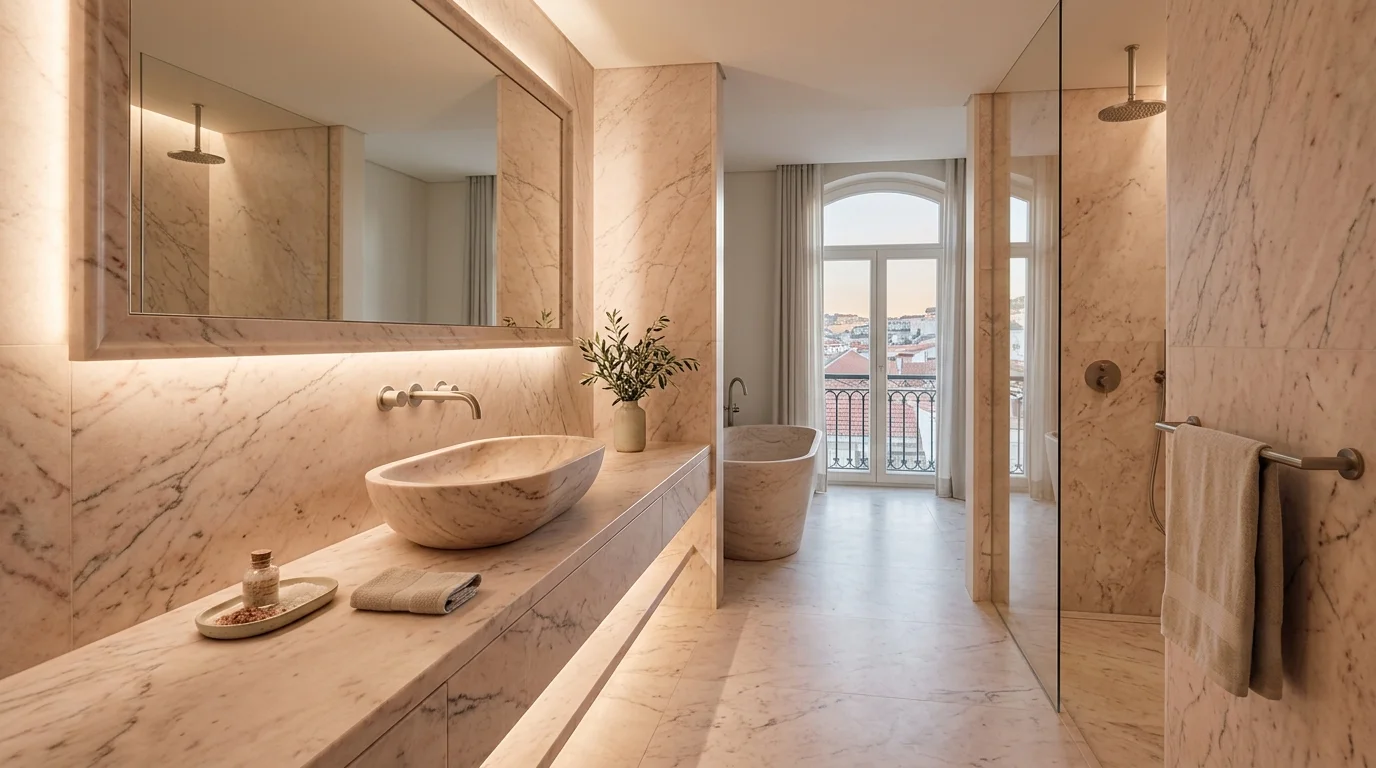
In the suites, Estremoz marble finds its most intimate register in the bathroom: wall cladding, vanity top, a freestanding tub framed in stone. Rose and creme bring warmth without noise. The operating rule: as a calcitic stone, it is acid-sensitive. Lemon juice, an unsuitable cleaning product or a spilled fragrance will etch an unsealed surface. That is not a flaw in the stone; it is a maintenance decision taken during the project, not after.
In the spa and wet areas — a field we cover in detail across our wellness work — the stone can be superb and dangerous at once. Superb for the thermal-bath sensation of noble material beside water. Dangerous if specified polished: wet, it slips. The answer is finish — honed, brushed or leathered — which restores grip without surrendering nobility, and a joint layout that controls where moisture gathers.
And the most common error: very high-traffic floors with no thought given to finish or format. A service corridor, the main entrance of a high-volume resort, the luggage zone. There the stone suffers. That doesn't mean ruling it out — it means a less delicate variety, a finish that hides wear and a plan to replace pieces. When traffic is extreme and the maintenance budget tight, sometimes the honest decision is not to use it. That "no" is criteria too.
Estremoz versus Carrara: The Provenance Decision
The comparison with Carrara is inevitable and, badly framed, unfair. Estremoz is not a cheap substitute for Italian marble. It is another stone, with another veining, another history and another provenance logic. Framing the choice as "which imitates the other better" starts wrong.
For a hotel in Portugal — or Spain — the variable that has shifted in recent years is provenance. Natural stone has returned to the centre of high-end hospitality interiors: in 2026, outlets such as Retail Focus place it as a lead material rather than an accent, valued for tactility, provenance and long-term worth. And local provenance is no longer just a romantic argument. Market analysis by Mordor Intelligence notes that local sourcing cuts freight emissions and reinforces regional character — a criterion that weighs in certifications such as LEED v5, where much of the available credit aligns with embodied carbon. The revised EU Construction Products Regulation, moreover, tightens embodied-carbon disclosure, as MarkWide Research reports.
In project terms this becomes concrete. Specifying Estremoz for a hotel in the Alentejo, the Douro or Lisbon — including the complex operations of historic building conversion for hotel use in Lisbon, where local stone provides historical continuity before any decorative element — means stone that has travelled hundreds of kilometres, not thousands. It means traceability — increasingly, studios specify through a direct quarry relationship rather than a distributor — and it means the material tells the place where the hotel stands, instead of contradicting it. A Portuguese hotel clad in Portuguese stone has a coherence no imported marble can buy.
None of this means giving up Carrara when the project calls for it. It means choosing with criteria, not by default. The right question is not "which is better?" but "which belongs to this hotel?". In Iberia, the answer is often in the Alentejo.
How Much Does Specifying Estremoz Marble Add to a Project?
It depends — and anyone quoting a fixed figure without seeing the project is guessing. Four variables move the cost of specifying Estremoz marble: variety (rose, being rarer, costs more than creme or standard white), format (large pieces and bookmatch raise extraction and block selection), finish (honed, brushed or leathered add labour over basic polishing) and transport and installation.
Against imported stone, proximity helps on the transport line for an Iberian hotel. But the real saving is not there: it is in the life cycle. A dense, low-porosity stone, well specified and well maintained, lasts decades and ages upward, not down. Compared with a marble-effect porcelain — cheaper up front — natural stone loses on initial cost and wins on permanence and perception. For a hotel that prices on experience, that difference is recovered.
The most expensive budgeting error is not choosing Estremoz. It is specifying it badly: the wrong finish in a wet area, a format impossible to replace, no sealing protocol. There the overcost arrives later, on site and in operation. Criteria are cheap at the start.
Stone as a Decision, Not a Finish
Estremoz marble is not an ornament added at the end to move up a category. It is a decision taken early, with the building in hand: where it goes, with what finish, in which variety, with what maintenance and with what sense of place. Taken well, that decision holds the project for decades. Taken badly, it shows in the first year.
A hotel that works its stone from criteria — not from a catalogue — does not buy marble. It buys permanence. You can see how we apply the same principle across hotel interior design and in our studio approach. The stone is simply the most honest example: it lasts as long as a good decision.
Véline Interiors · Hospitality Design
The right marble in the right place is never improvised
If this criteria fits your hotel project, the conversation is open.
Let's talk about your project →