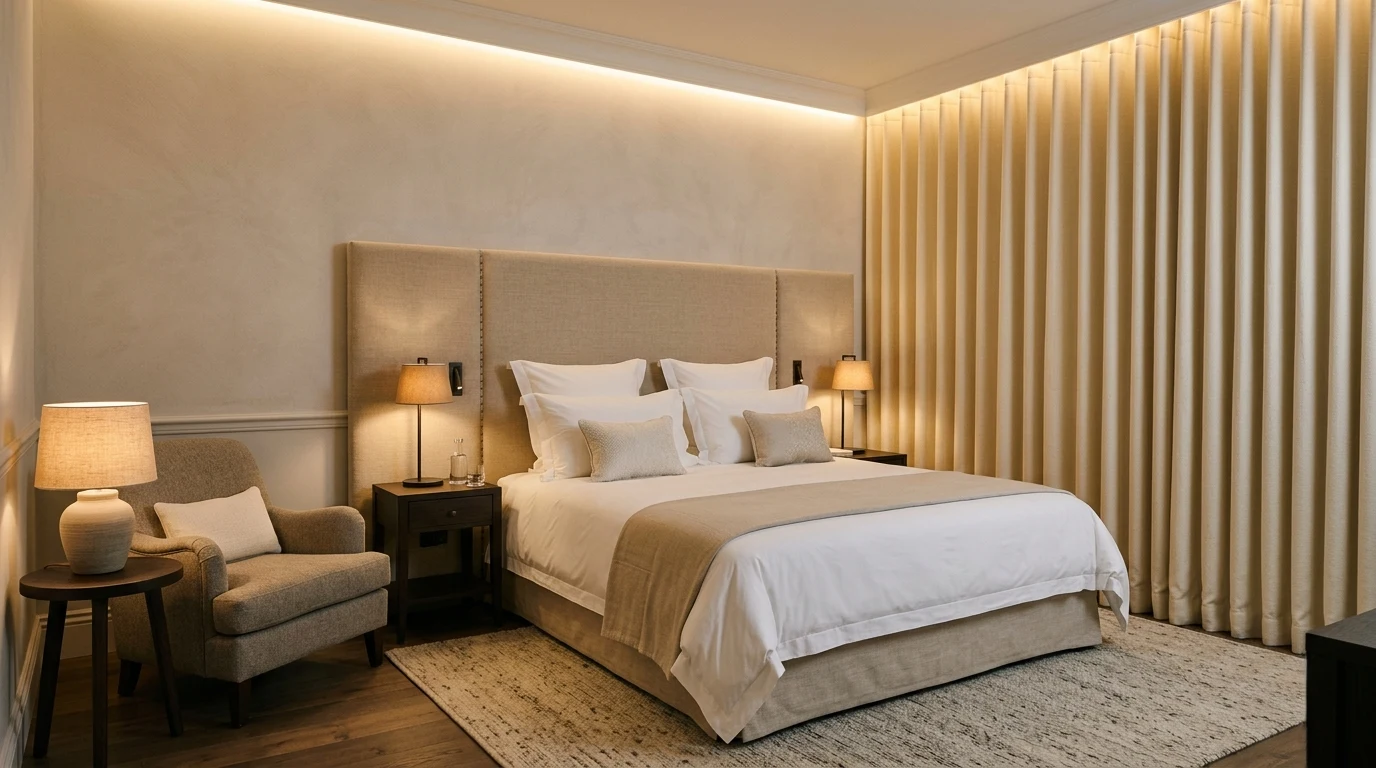
The most common mistake in hotel interior design projects is choosing a fabric by the swatch and discovering its real behaviour at the first post-opening review. A linen that looks right but tests at 15,000 Martindale cycles will show visible wear on a hotel headboard before eight months. A curtain that appears opaque but fails EN 1021 can create a compliance problem at the first inspection. A high-thread-count bed linen with low weave density survives industrial laundering poorly and loses body before the guest ever notices in hand.
What follows is a guide to textile specification for hotel projects: by area, with the technical thresholds that matter and the materials that meet them without sacrificing the space's aesthetic criteria.
Martindale: the metric that governs upholstery specification
The Martindale test measures a fabric's resistance to abrasion in standardised multidirectional friction cycles. It is the reference standard in Europe for contract upholstery and the first value a hotel project manager should request before approving a fabric sample.
Zone thresholds in hospitality, per contract specification practice documented by manufacturers such as Kothea and Atlanta Contract Furniture, are as follows: guestroom (chairs, armchairs, moderate-use headboards), minimum 40,000 cycles; restaurant and bar, minimum 60,000 cycles; lobby and constant-traffic areas, 80,000 to 100,000 cycles. Any value below those thresholds corresponds to residential or semi-professional use and produces visible wear in hospitality in under twelve months, forcing premature replacement and destroying the return on the initial investment.
The most frequent confusion in specification is assuming a high Martindale value necessarily means a technical, synthetic-looking fabric. It does not. A heavyweight contract linen can reach 80,000 cycles with all the texture and visual character of natural linen, when woven with the correct density and yarn type. Technical specification and aesthetic criteria do not compete — they only compete when the selection process starts from the swatch instead of from the technical data sheet.
One important procedural detail: the Martindale value should be requested as certified by an independent laboratory, not from the manufacturer's marketing sheet. A serious contract supplier hands over the test report without being asked. If they cannot, they are not a contract supplier — they are a residential supplier selling into the hotel channel.
Flame retardancy: EN 1021 and what a fabric certificate does not guarantee
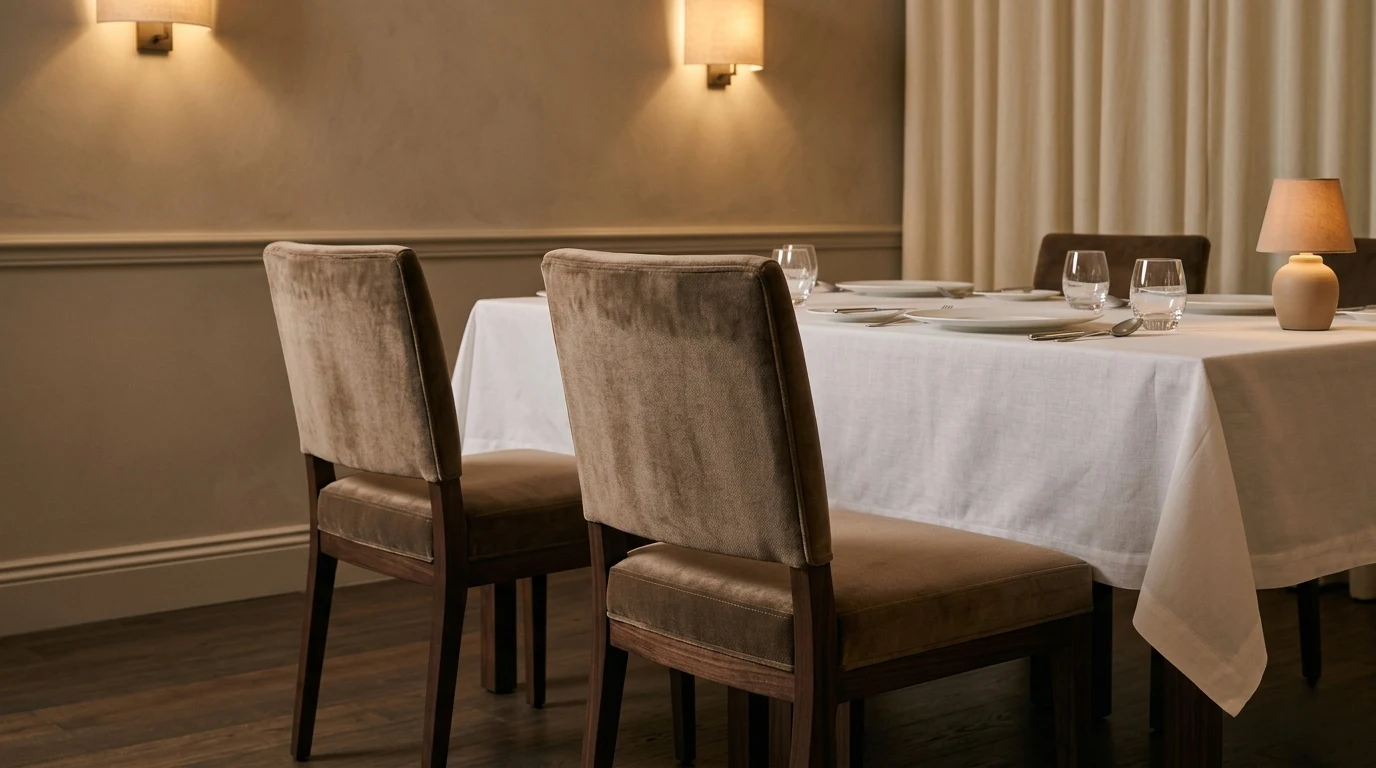
In Spain and Portugal, all upholstery in hotel public-use areas must meet at minimum EN 1021-1 (resistance to cigarette ignition) and EN 1021-2 (resistance to match-flame ignition). Both parts are required for any seating in common areas: lobby, restaurant, bar, meeting room, waiting area.
The critical nuance that hotel specification practice frequently overlooks is that EN 1021 evaluates the full assembly — outer fabric, interliner if present, filling and seat base — not the fabric in isolation. A fabric with its own individual flame-retardancy certificate does not automatically make a compliant assembly. If that fabric is combined with a different filling or interliner than the one tested, the assembly as a whole may not meet the standard even though the fabric carries its own certificate. The correct approach is to require certification of the full assembly exactly as the seat will be manufactured.
In category hotel projects, it is common to add OEKO-TEX Standard 100 certification, which verifies the absence of harmful substances in the textile: banned azo dyes, formaldehyde, heavy metals. It is not a regulatory requirement in most cases, but it is a quality argument to the guest and to the hotel classification bodies that increasingly value an establishment's materials profile.
In hotel interior design projects, the technical documentation for each fabric — Martindale, EN 1021, OEKO-TEX, ISO 105-B02 colour fastness — should form part of the specification dossier delivered to the client before materials approval. Not as a bureaucratic requirement, but as assurance that the aesthetic decision is backed by verified technical behaviour.
Linen, velvet and jacquard: the fabrics of contemporary neoclassical criteria
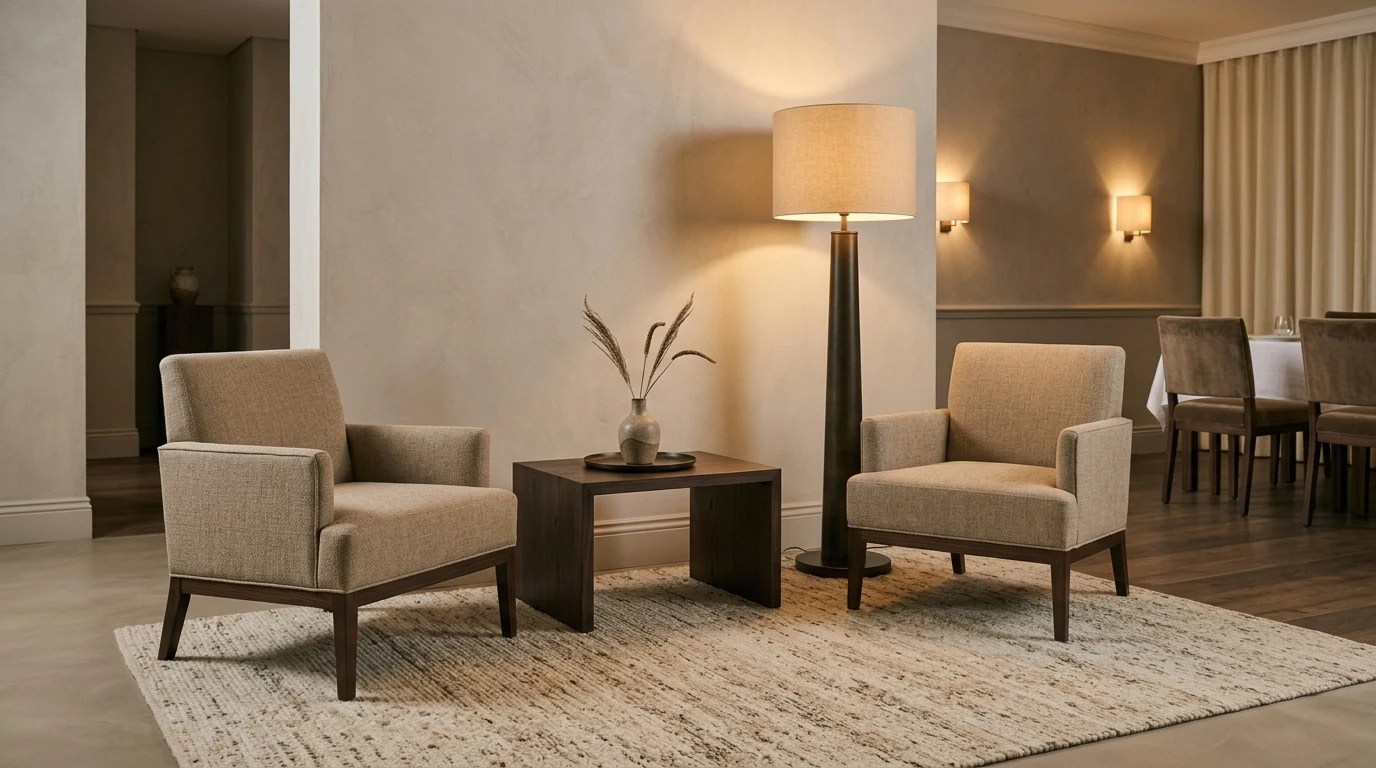
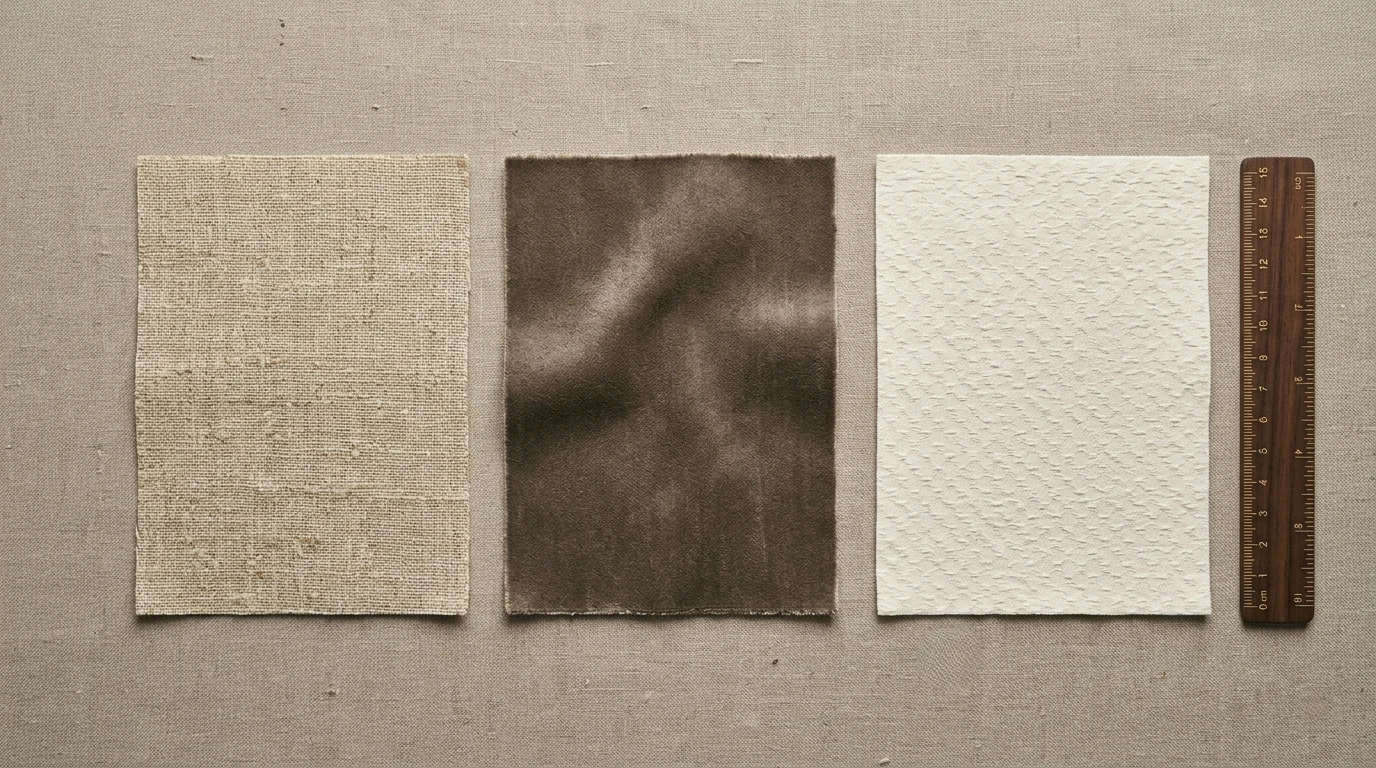
In the aesthetic language of contemporary neoclassicism that defines this studio's criteria, three fabrics occupy central positions in hotel specification: contract linen, contract velvet, and heavyweight jacquard. All three share the ability to deliver visual depth without ornament, texture without a complex pattern, and character without needing intense colour. And all three have technical versions that meet the Martindale and flame-retardancy thresholds of the most demanding hospitality projects.
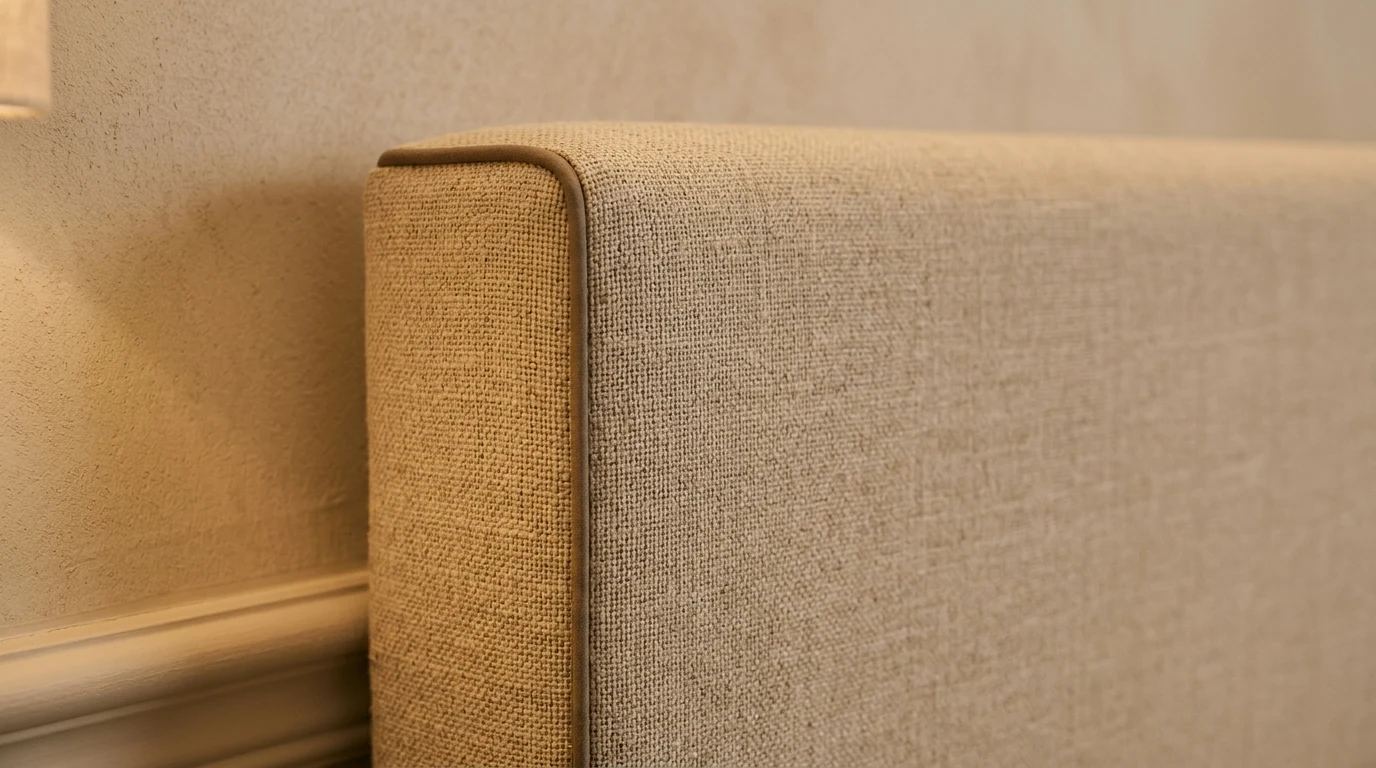
Contract linen is the fabric that best resolves the paradox of hotel specification: natural appearance and technical performance. A dense-weave linen, with medium-low count yarn and a natural finish free of brighteners, has a texture that synthetic jacquard cannot replicate. With the right composition — linen treated with a reinforcing interliner, or linen blended with a small proportion of technical fibre — it can reach 80,000 Martindale cycles while keeping the hand and feel of pure linen. On guestroom headboards, suite armchairs and wall panels, it is the fabric that appears most often in high-tariff boutique projects across Spain and Portugal.
Contract velvet solves the luminosity problem: in indirectly lit spaces — which contemporary neoclassical criteria favour — velvet catches light in a way no flat fabric matches. The tonal variation between folds, the colour shift with viewing angle, the apparent depth of colour: these are optical effects of the velvet pile that turn a sofa or headboard into a design element with its own presence. In contract versions — cut-pile fabrics with a reinforced warp base — velvet reaches 100,000 Martindale cycles or more, with inherent or applied flame treatment depending on fibre composition.
Heavyweight jacquard is the most versatile fabric in hotel projects seeking a low-intensity geometric pattern: fretwork, herringbone, simplified damask. Its manufacturing process — the yarn forms the pattern in the weave rather than being printed onto the surface — guarantees the pattern does not wear down with use or lose definition in laundering. At weights above 350 g/m², jacquard has enough structural solidity to be used on headboards, wall panels and chair upholstery without an additional interliner.
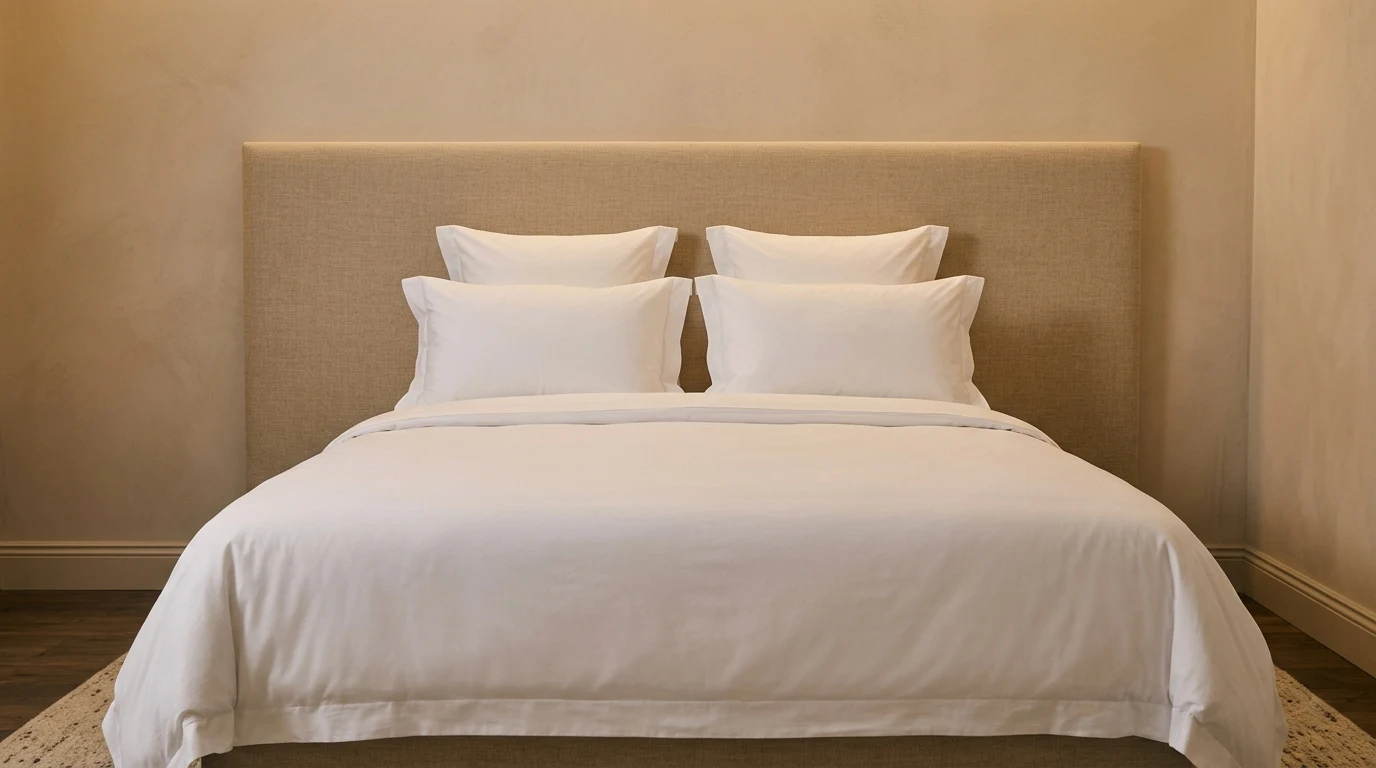
Bed linen: weight, yarn and industrial laundering
Bed linen is the highest-rotation textile in a hotel and the one that most directly determines the perception of quality before the guest touches anything else. Its specification does not come down to thread count — a figure hotel marketing has turned into a number stripped of context — but to the combination of three variables: fibre composition, weight, and weave construction.
Fibre composition determines feel and laundering behaviour. Combed Egyptian or Pima cotton — long fibre, fine yarn, smooth surface — offers the best balance of softness, wash resistance and colour durability. Percale — a high-density plain weave — has a crisp feel and stable dimensional behaviour after a hundred industrial washes. Sateen — a weave with a lustrous outer face — is more delicate and requires more careful wash-temperature and spin-cycle specification to keep its characteristic sheen.
Weight — expressed in g/m² — matters more than thread count for industrial-laundering durability. A weight of 140 to 180 g/m² in sheets is the standard range in luxury hospitality: below it, the fabric loses body after twenty or thirty industrial wash cycles; above it, drying time and laundry energy use increase, with an operational cost impact the hotelier feels in the monthly bill. In duvet covers and pillowcases, weight must also account for breathability: high fill-power down — 750+ cuin — needs a cover with an air permeability that very high-weight fabrics restrict.
Industrial laundering subjects textiles to conditions domestic laundering never reaches: temperatures up to 85°C, alkaline detergents, high-speed spinning, calendering. A textile not specified for that cycle — tested with AATCC 61 for colour-wash fastness and AATCC 150 for dimensional change — can show deteriorated appearance and dimensions before six months of use. The minimum acceptable standard is under 2% shrinkage in warp and weft after repeated washing.
Curtains: opacity, drape and coordination with lighting criteria
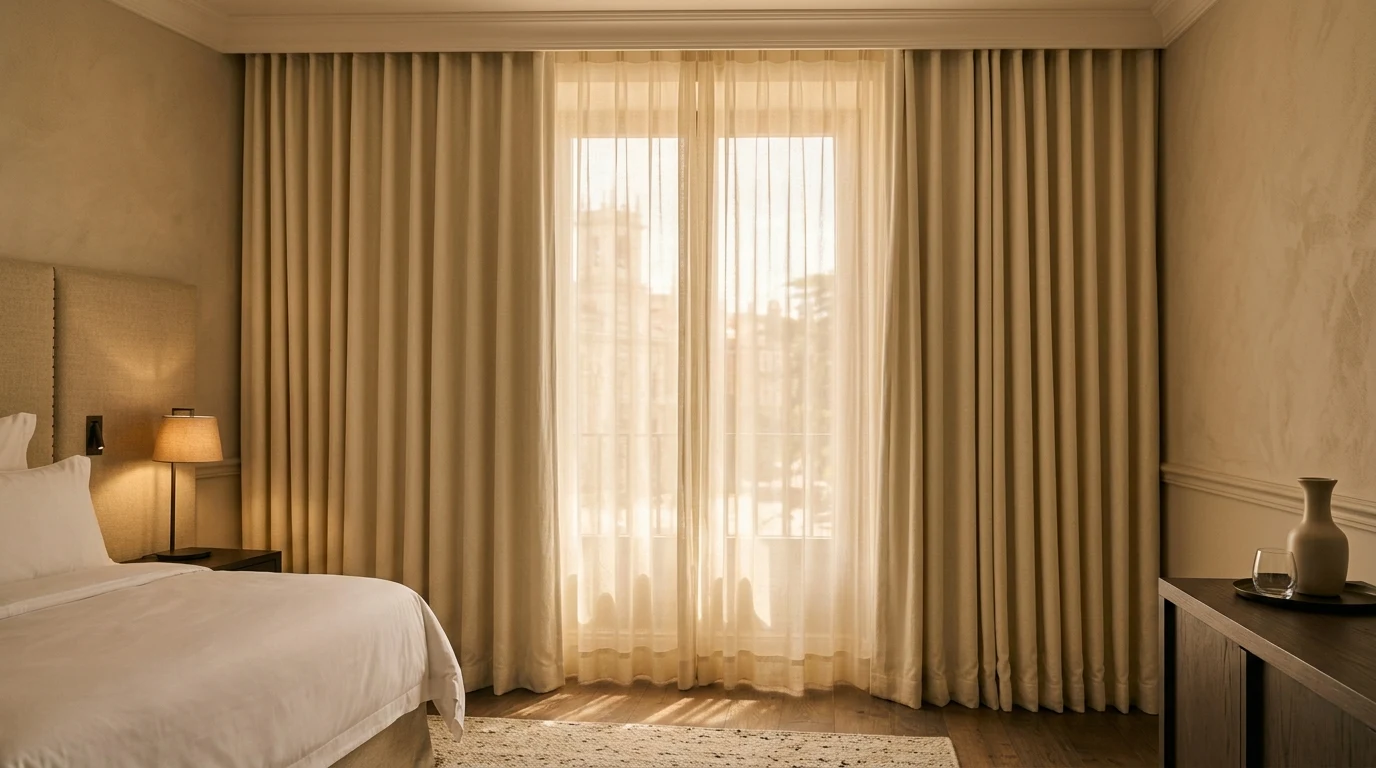
A hotel room curtain performs three simultaneous functions that specification must resolve in an integrated way: control of exterior light, partial thermal and acoustic insulation, and definition of the space's visual character. The common mistake is specifying it only for its opacity function — blackout, yes or no — without considering its contribution to the room's overall aesthetic and sensory quality.
In hotel interior design with criteria, curtains are designed in two layers: a translucent sheer — in linen, batiste or synthetic silk organza — that filters natural light during the day, and a heavy-cloth opaque curtain that closes fully for rest. The double layer is not an unnecessary expense: it is what allows the guest to regulate light entry across a range from diffuse luminosity to total blackout, without the room losing character at either extreme.
Drape — the fabric's vertical behaviour under gravity — is the primary aesthetic criterion for a curtain. A heavy linen or wool cloth falls in straight vertical folds that frame the window with presence and visual weight. A low-weight synthetic fabric tends toward irregular folds and static cling. Curtain specification in a luxury hotel project always includes fabric weight, the type of heading (triple pinch pleat, eyelet, box pleat) and installation height: curtains that begin 10 cm from the ceiling and reach the floor make the room feel taller; those that start at the window lintel limit it.
From an acoustic standpoint — which holds a central place in wellness space design — double heavy-cloth curtains contribute to controlling reverberation time in rooms with large windows. In hotel bedrooms with predominantly hard surfaces, they are frequently the most effective absorption element per square metre.
How many Martindale cycles does a fabric need for hotel use?
Minimum thresholds vary by zone. Guestrooms (chairs, armchairs, moderate-use headboards): 40,000 cycles. Restaurant and bar: 60,000 cycles. Lobby and constant-traffic areas: 80,000–100,000 cycles. Lower values correspond to residential use and produce visible wear in hospitality before twelve months. Correct specification is not always choosing the highest available value — some contract linens reach 80,000 cycles with all the aesthetic character of natural linen — but matching the threshold to each zone's actual exposure. The value should be certified by an independent laboratory, not taken from a supplier's marketing sheet.
Which flame-retardancy standard applies to upholstery textiles in Spanish and Portuguese hotels?
The minimum standard across the European Union for upholstery in hotel public-use spaces is EN 1021-1 (resistance to cigarette ignition) and EN 1021-2 (resistance to match-flame ignition). Both parts are required in Spain and Portugal for any seating in common areas. The standard evaluates the full assembly — fabric, filling and interliner — not the fabric in isolation. A flame-retardant fabric certificate does not automatically make a compliant assembly if the components differ from the tested combination. Category projects typically add OEKO-TEX Standard 100 certification, which verifies the absence of harmful substances in the textile.
The textile that lasts is the one specified before it is chosen
A hotel does not change its textiles every season. It selects them for a five-to-ten-year life cycle, under a level of use no residential context matches. Correct specification is not the one that produces the prettiest showroom sample: it is the one that produces the correct behaviour in year three of operation, when the laundry has processed the fabric four hundred times and two full summer seasons of sun have hit the curtains.
The contemporary neoclassical criteria that define this studio's work is not at odds with that technical demand. On the contrary: linen at 80,000 Martindale cycles, velvet with inherent flame retardancy, heavyweight jacquard, Egyptian-cotton bed linen with AATCC testing — these are exactly the materials that belong to the aesthetic language of luxury interior design and that simultaneously meet a hotel's operational requirements. Durability, in hotel textiles, is not a concession to pragmatism: it is a condition of good criteria.
In this studio's hotel interior design projects, textile specification is always delivered with a verified technical data sheet before any sample enters the space. Not as excessive rigour, but because replacing a fabric after upholstering a hundred chairs costs more than specifying it correctly from the start would have.
Véline Interiors · Quiet Luxury
Does your project's textile still lack a verified technical data sheet?
If your project is in the materials specification phase and the textile still lacks a verified technical data sheet, that is the starting point.
Present your project →