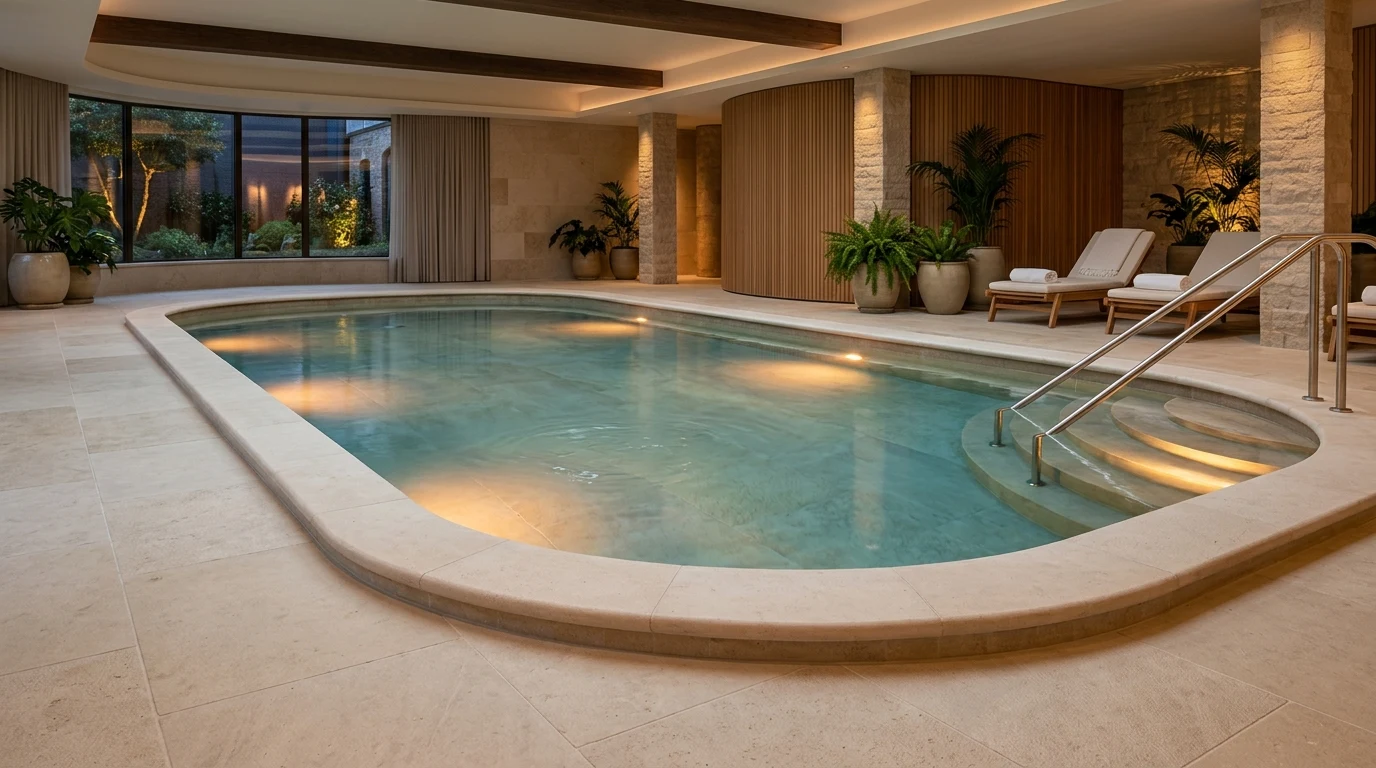
The wet zones of a spa — indoor pool, hammam, sauna, shower zone, changing rooms, foot zone — each have specific technical conditions that determine which materials are suitable and which are not. Those conditions are non-negotiable: they are set by safety regulations and dictated by the durability of the building. Ignoring them for aesthetic reasons is the most expensive error that can be made in this type of project.
The primary criterion: slip resistance before aesthetics
European standard UNE-EN 16165:2022 classifies flooring in wet zones by slip resistance under humidity conditions, from Class 1 (minimum) to Class 3 (maximum). Pool edges, showers and bathing zones in public installations in Spain require Class 3 as a minimum. Changing rooms and humid walkways require Class 2 as a recommended minimum.
This criterion comes first, before any aesthetic consideration. Polished marble is visually superior to any alternative in a five-star spa. It is also unsuitable in any wet zone: polished marble has a friction coefficient below 0.3 in wet conditions — the minimum safety threshold. The same marble in honed or aged finish can reach 0.5–0.6 in wet conditions if correctly specified.
Large-format porcelain (minimum 60×60cm) with natural or certified anti-slip finish meets safety requirements with a high-end visual equivalent to natural stone. Portuguese limestone with flame finish achieves Class 3 values while retaining the appearance of untreated noble stone.
Indoor pool zone: the highest technical demand
The indoor pool zone has the most technically demanding conditions in the entire project: permanent contact with chlorinated or salt water, elevated water temperature (28–34°C) producing constant steam, intensive traffic from barefoot users, and impact loads from sudden movements.
Porcelain with water absorption below 0.5% (group BIa to EN 14411) is the material with the best performance-to-cost ratio for this zone. Large-format stone-effect porcelain (minimum 60×60cm) in natural or certified anti-slip finish is the standard solution in four- and five-star spas in Spain and Portugal. The large format reduces the number of joints — the main point of algae and bacteria accumulation and the most difficult to clean. For the pool interior, light-coloured porcelain (white, cream, soft grey) best reflects underwater lighting and gives the clearest water appearance.
Natural stone — travertine, limestone, slate — is viable in the pool perimeter with adequate treatment: penetrating resin waterproofing, epoxy joint sealing resistant to chlorine and antifungal agents, and flame or bush-hammered finish to guarantee the required anti-slip class. Installation cost is 40–80% above porcelain, but the visual result is significantly more exclusive. Pool coping — the edge where the user rests hands and exits the water — must have a rounded or bevelled profile, never a sharp arris.
Hammam: the floor that must withstand 100% constant humidity
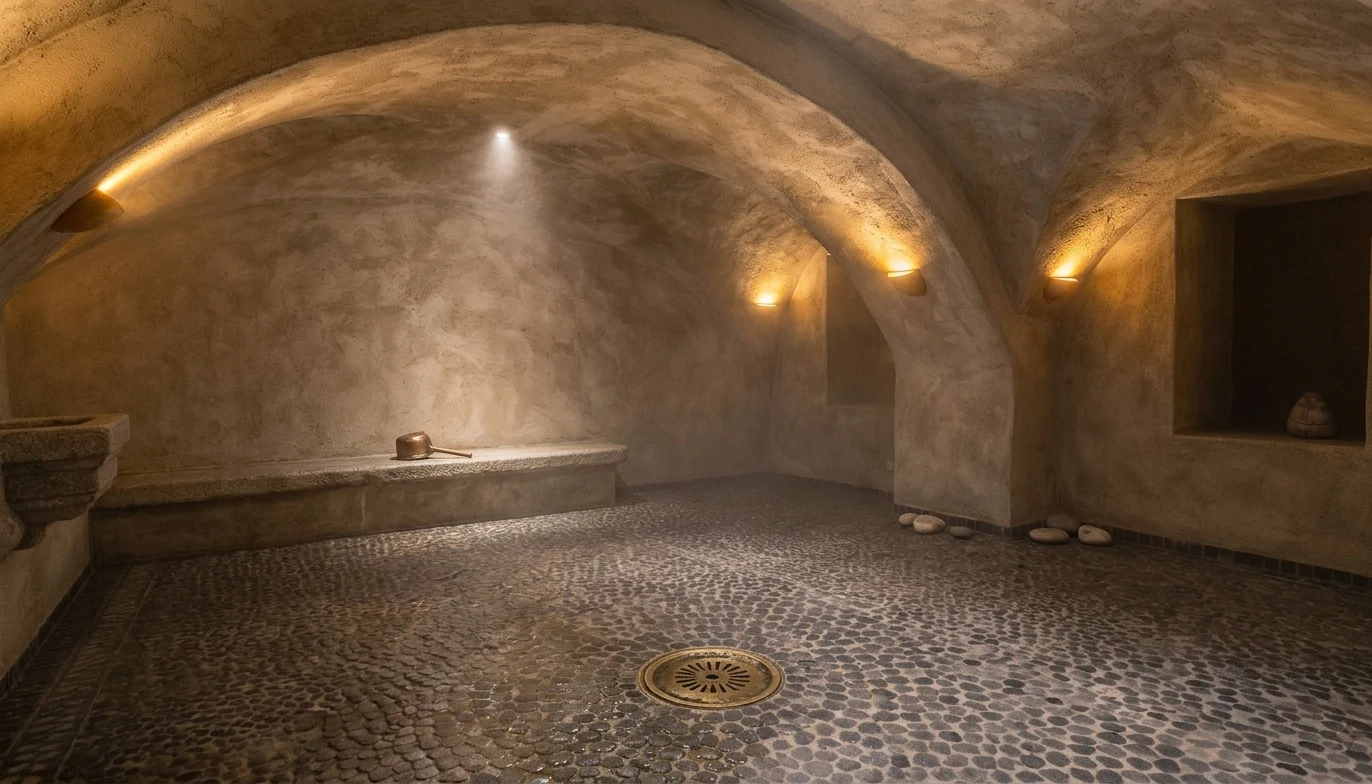
The hammam has the most chemically aggressive conditions in the spa: constant steam at 100% humidity, 40–50°C temperature, water with variable pH from treatment products, and prolonged skin contact requiring surfaces with pleasant tactile temperature.
The correct hammam floor has three simultaneous requirements: total base waterproofing (impermeable membrane under the finish material), low-porosity finish material with epoxy joint sealing, and minimum 1.5% slope toward the central drain without water accumulation zones. The drain must be centred exactly at the lowest point: a 5mm difference between opposite points produces water accumulation that accelerates material degradation and promotes fungal growth.
The most suitable materials for luxury hotel hammam: Moroccan zellige (high-fired glazed ceramic, absorption below 3%) on floor and walls — its natural chromatic variation between pieces produces a living, unrepeatable surface that no industrial material replicates; white matt marble or limestone on the heated bench; lime plaster with pigment on the vault, where temperature and humidity are at maximum and lime absorbs and regulates without degrading. The combination of zellige on the floor, marble on the bench and lime on the vault produces the greatest visual and technical coherence in a luxury hammam.
Sauna: the only space where timber is the correct flooring
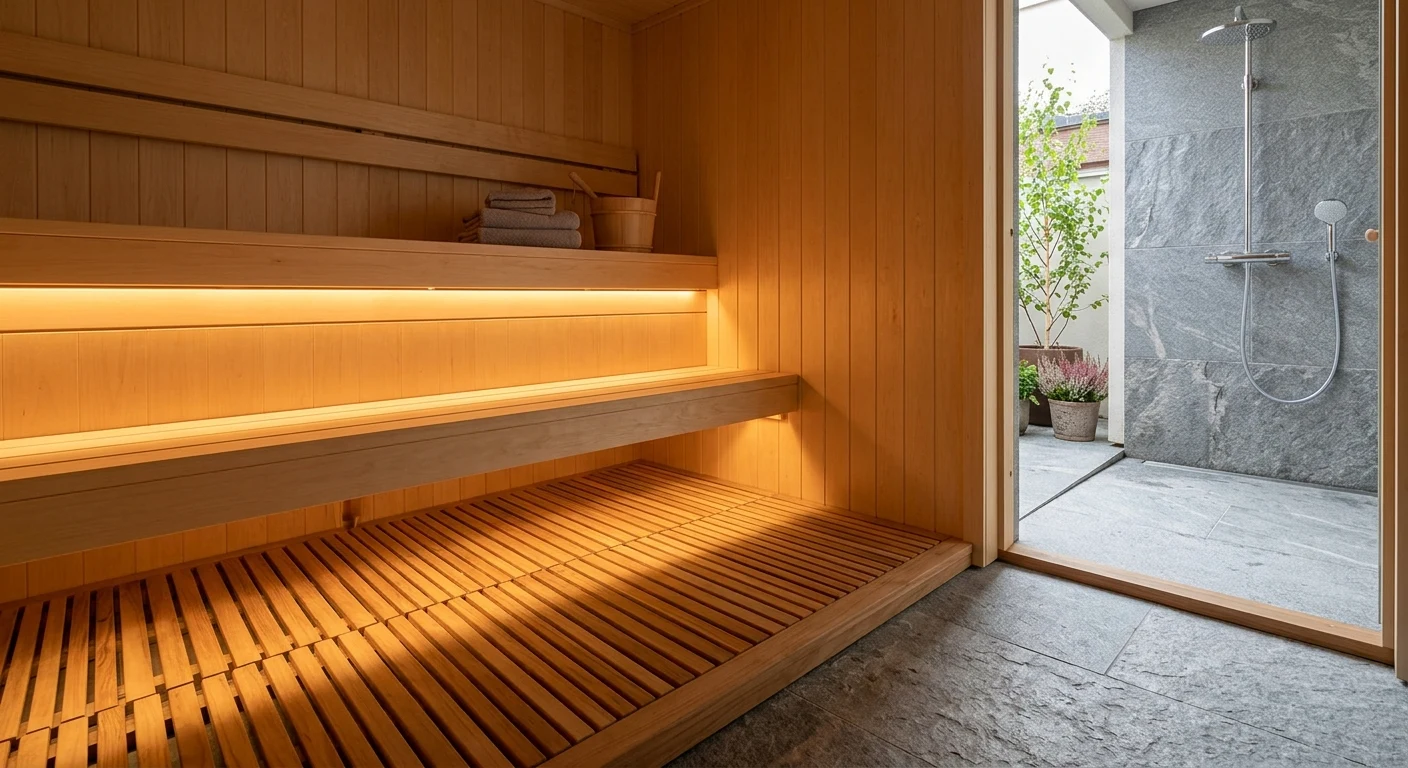
The sauna operates at 80–95°C with variable humidity between 5% and 60%. Under those conditions, stone, porcelain and microcement store heat and become burn surfaces at foot contact. Timber is the only flooring material that maintains surface temperature in tolerable ranges at those ambient temperatures.
The correct species for sauna interiors: teak (Tectona grandis), abachi (Triplochiton scleroxylon), birch (Betula spp.). All three have thermal conductivities that prevent burn on contact. Pine, oak and beech — more economical — reach higher contact temperatures and are unsuitable for sauna interiors. The timber must be naturally or kiln-dried without surface treatments: varnishes, oils or lacquers produce toxic fumes at 90°C.
The transition zone between the sauna and the contrast shower or rest area has different conditions: high humidity but moderate temperature (20–30°C). The correct flooring in that transition zone is Class 3 anti-slip stone or teak treated with outdoor water-repellent product. The joint between the timber interior of the sauna and the exterior stone must be resolved with an anodised aluminium or stainless steel profile that allows differential expansion of both materials without cracking.
Changing rooms and shower zones: where the most errors occur
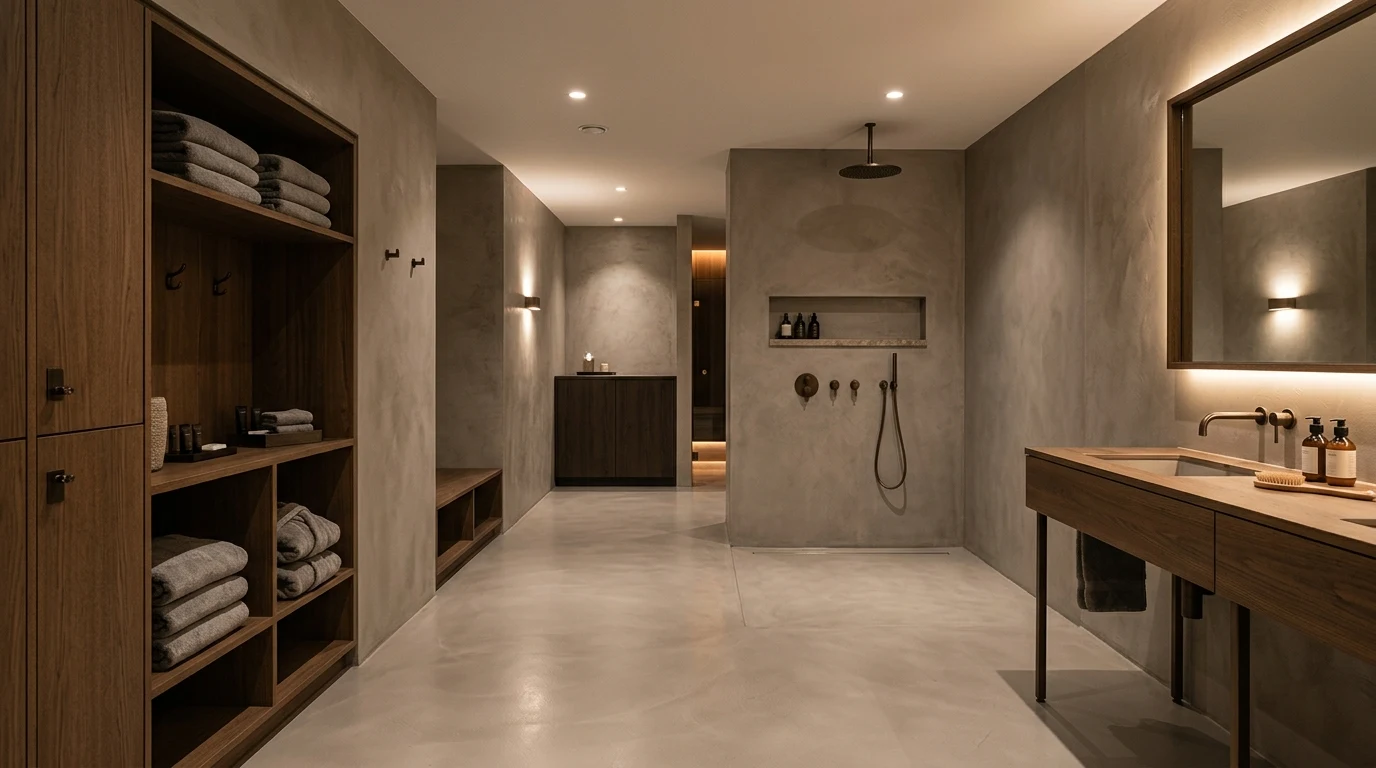
The changing room is the space where the most flooring errors occur in hotel spas. The reason: it is designed as a transition space, with less attention than the pool or hammam, and materials are installed that cannot withstand the combination of intensive use, moderate-high humidity and variable temperature.
Sealed microcement has grown most in luxury hotel spa changing rooms over the last five years. Advantages: monolithic appearance without joints (eliminating the main bacterial accumulation point), pleasant tactile temperature when combined with underfloor heating, and ability to cover irregular surfaces without prior demolition work — a significant advantage in renovations. Its critical requirement: waterproofing with contract-quality product (two-component polyurethane or low-viscosity epoxy) in at least three layers over cured microcement. Without that sealing, microcement absorbs humidity and stains within weeks of intensive hotel use. It also requires resealing every 2–3 years in intensive use — a maintenance cost that must be incorporated into the operational budget.
Large-format porcelain (120×60cm or 120×120cm) in textured finish is the more robust and lower-maintenance alternative: zero absorption, chemical resistance to chlorine and cleaning products, and Class 2–3 anti-slip in natural finish. For projects where priority is durability and low operational maintenance, porcelain is the correct choice. For projects where the monolithic aesthetic and integration with underfloor heating are priorities, sealed microcement with programmed resealing is the appropriate option.
Underfloor heating in wet zones: the most underused decision
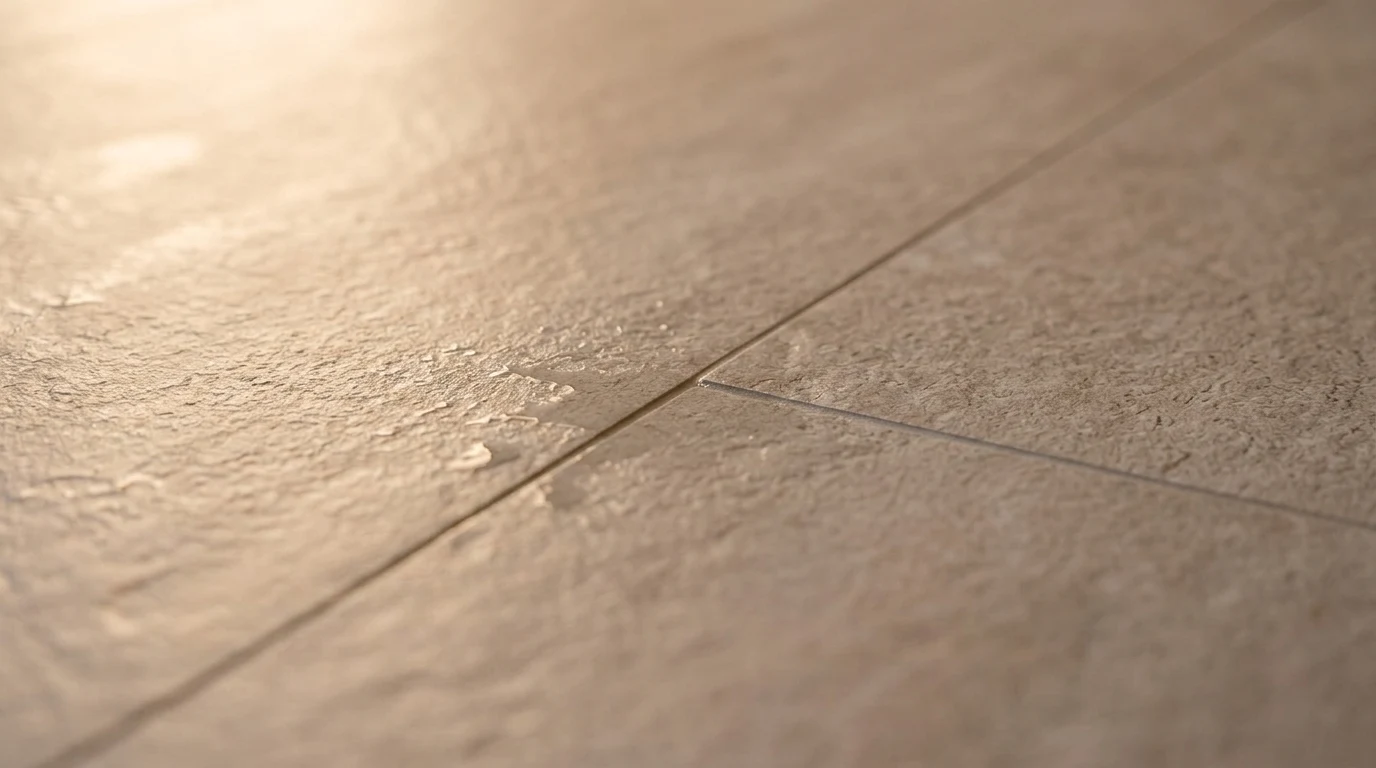
Underfloor heating in spa wet zones — changing rooms, foot zones, pool perimeter — is probably the most underused installation decision in luxury hotel spas. Its incremental cost over standard installation (€30–60/m² additional) is minimal compared to the guest experience impact: stepping barefoot onto a warm surface (28–30°C) rather than a cold one is a wellbeing difference the guest perceives immediately and mentions in reviews.
Underfloor heating in wet zones requires a water system (cross-linked polyethylene pipe in mortar bed) or low-power electric cable. In pool zones, the water system is more efficient for large surfaces. In changing rooms and showers, the electric system is easier to install and control in independent zones, allowing activation only during spa operating periods — which significantly reduces energy consumption.
The flooring material over underfloor heating must have high thermal conductivity: porcelain is the material with the best heat transmission from the slab to the surface (thermal conductivity 1.5–2.5 W/mK). Microcement has similar conductivity when applied in thin layers. Timber is the worst thermal conductor (0.13–0.17 W/mK): compatible with underfloor heating in saunas at low emission temperature, but inefficient in changing rooms. Natural stone has variable conductivity depending on the species: granite (2.5–3.0 W/mK) is the natural stone material with the best thermal transmission, even above porcelain.
Spa and wellness space design in boutique hotels and luxury villas in Spain and Portugal includes complete flooring specification by zone as part of the project. If you have a spa project in development and want to evaluate the correct materials for each zone, the conversation is open.
Véline Interiors · Wellness Design
Have a spa project in development?
We specify the correct flooring for each wet zone, with technical and design criteria.
Present your project →