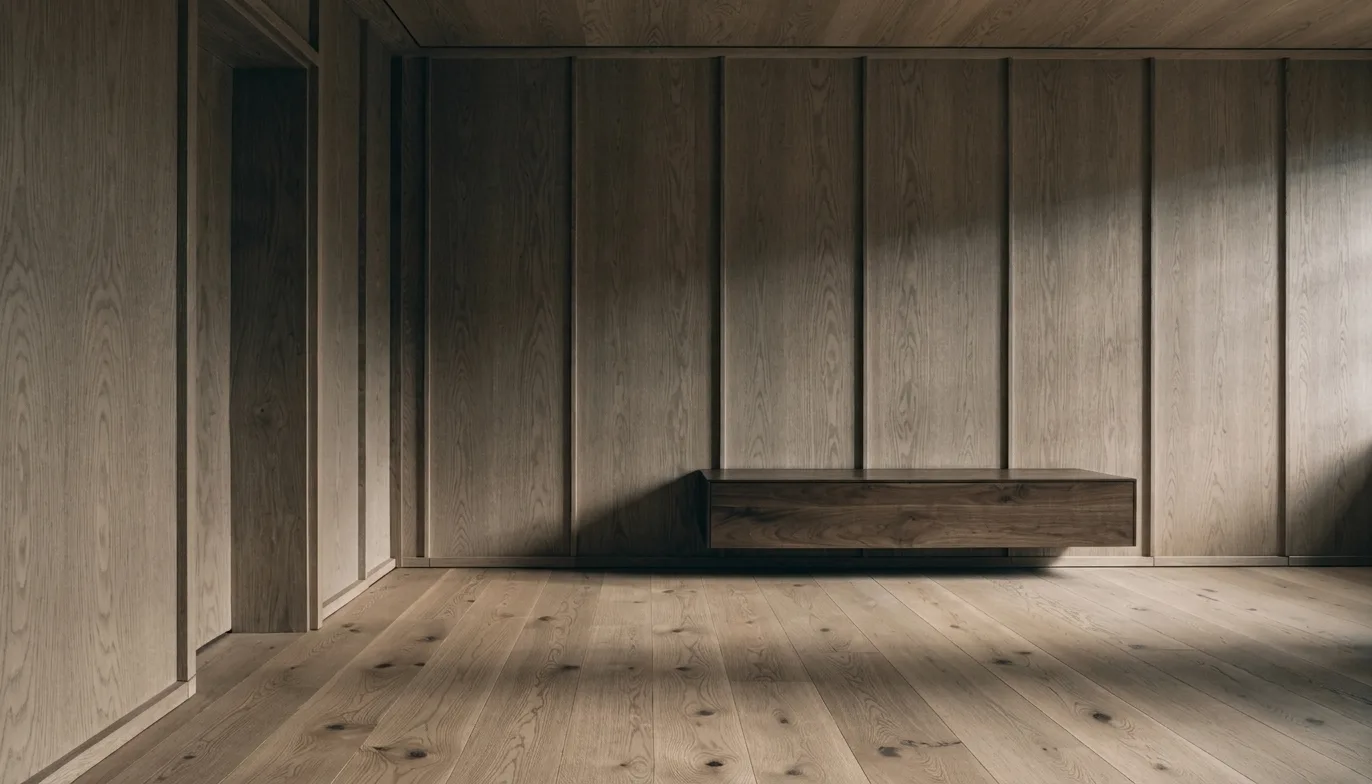
It is the most honest material in a project, and for that reason the one that exposes the most. A poorly chosen stone goes unnoticed; a poorly resolved wood shows in the touch, in how light falls across the grain, in how it behaves six months after handover. In hospitality and high-end residential work, where the guest or owner touches surfaces daily, that honesty allows no shortcuts. This article sets out the four decisions that turn a correct wood into a considered one.
Why Wood Exposes Design Judgement
Almost the entire conversation about wood in interiors stops at the adjective: warm, natural, timeless. These are truths repeated so often they no longer say anything. The problem is that they describe the material without deciding anything about it.
A design decision begins where the adjective ends. Specifying "fine timber" is not enough: one has to know why oak rather than ash on a high-traffic floor, why veneer rather than solid on a three-metre panelled wall, why an open-pore oil rather than a sealed varnish on a surface touched a thousand times a day. Each of these choices carries an operational consequence, not merely an aesthetic one.
Wood rewards judgement and punishes improvisation with a clarity other materials lack. The wrong finish does not age: it degrades. A species unsuited to its use does not patinate: it scratches, swells and splits. This is why, in studio practice, wood is always the last surface to be specified and the first to be protected: it sets the temperature of the space and concentrates the risk.
Species by Function, Not by Catalogue
The most common error is not choosing an ugly wood. It is choosing a beautiful wood for the wrong place. Species is not selected for its colour on the sample, but for what it will endure.
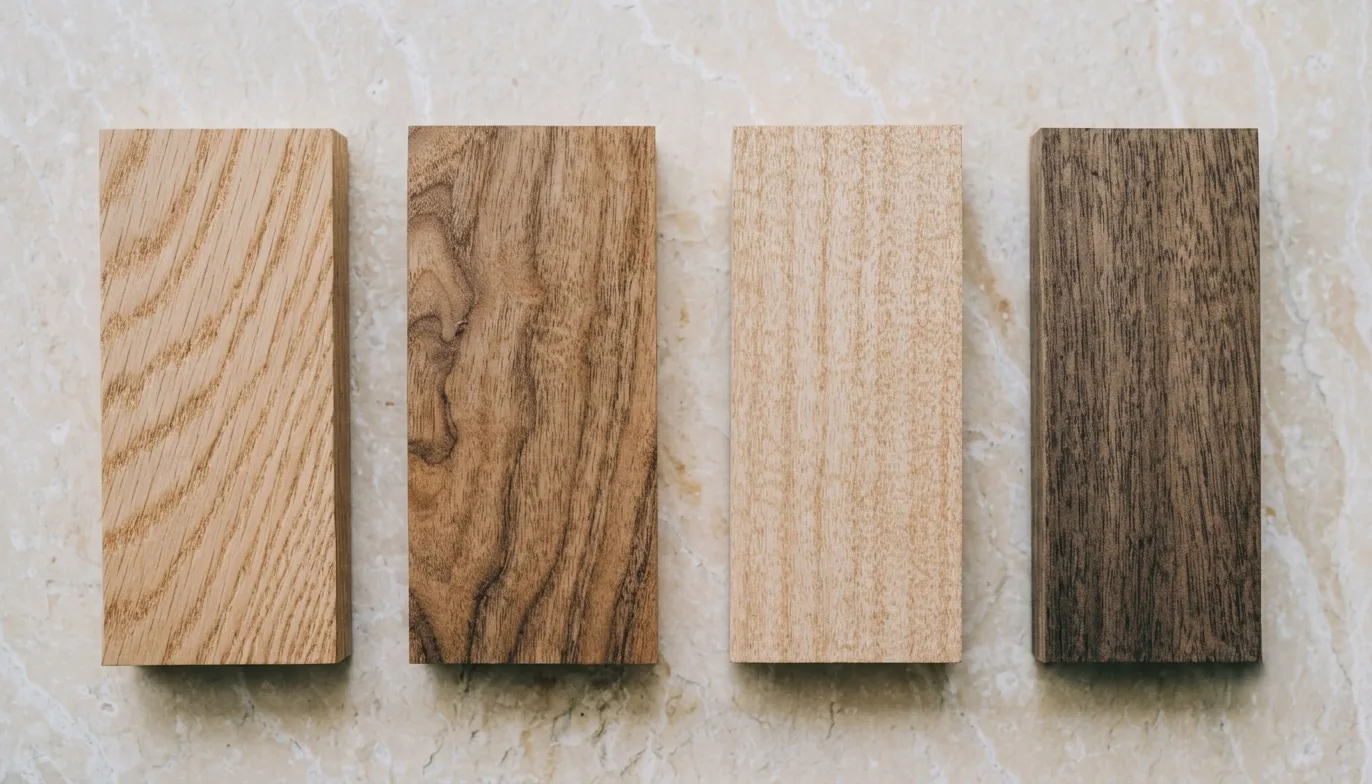
Oak (European, American white) is the defensible standard for floors and high-traffic surfaces: sufficient hardness, legible grain, stable behaviour. It accepts smoking, brushing and liming without losing identity. It is the sound answer when a project asks not for drama but for permanence.
Walnut brings tonal depth and a moving grain no stain can imitate. Its natural place is furniture, vertical cladding and the pieces the eye seeks out: a headboard, a reception front, a library. On heavy-traffic floors it loses its case on cost and hardness.
Ash is the timber of discreet luxury: pale tone, pronounced grain, visual lightness. It works where oak would feel predictable and walnut excessive.
Teak belongs to water. Its stability against humidity makes it irreplaceable in spa wet zones, villa bathrooms and any surface exposed to steam. Using it as a fashion outside that context wastes its only real virtue.
The technical reference that orders these decisions is the Janka scale, which measures each wood's resistance to indentation. It is not a decorative figure: it tells you whether a species will survive a suitcase wheeled across a suite floor eighty times a day. Choosing without it is decorating; choosing with it is designing. Where durability governs from day one, this logic connects with the reasoning we apply to the hotel lobby as a sales argument.
Veneer or Solid: The Decision Almost No One Explains
This is where serious interior design parts from the amateur. There is a belief that solid wood is always superior to veneer. In high-end work, the reverse is true more often than is admitted.
Wood veneer is a thin sheet of natural wood applied to a stable board. It is not an imitation: it is real wood, but decoupled from the movement of the substrate. Solid wood is the whole piece, with all its beauty and all its living behaviour.
The decisive difference is dimensional stability: a surface's ability not to move with changes in humidity and temperature. Solid wood breathes, expands and contracts; on a large-format panelled wall or a continuous run, that movement opens joints and compromises the finish. Veneer over a stable core does not. This is why on tall vertical cladding, on pocket sliding doors and on continuous surfaces without a visible joint, veneer is not the economical option: it is the technically correct one. Solid wood reclaims its place on the floor, in structural joinery and in pieces where the edge is seen and touched.
Specifying veneer where veneer belongs and solid where solid belongs is one of the most reliable signals that a studio, not a catalogue, stands behind the work.
Finish Changes the Material
Two identical oak boards can belong to different worlds depending on how they are finished. The finish does not protect the wood: it redefines it.
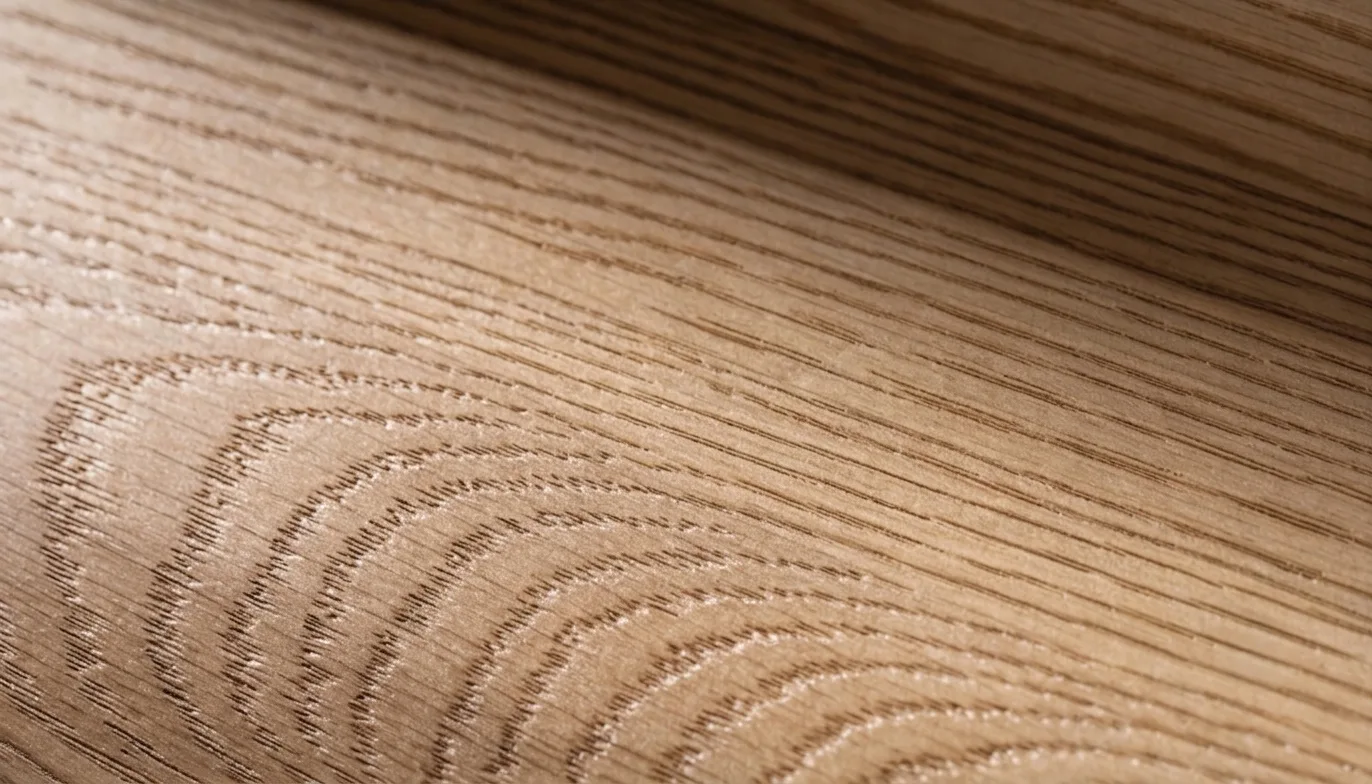
An open-pore finish — oils and waxes that penetrate without sealing the surface — leaves the wood real to the touch: the grain, the temperature, the texture are all felt. It ages with use, can be repaired in sections without sanding the whole surface, and communicates authenticity. It is the choice of a luxury that need not shine.
A sealed varnish forms a film over the wood. It protects better against liquids and stains, but cancels the touch and, once scratched, forces a full resurfacing rather than a local repair. In hospitality, that difference translates into years of maintenance: an oiled bar top is repaired overnight; a scratched high-gloss varnished one is replaced.
The decision is not aesthetics against practicality. It is understanding that in a space that is genuinely used, the correct finish is the one that ages with dignity and can be repaired — not the one that feigns perfection until the first scratch. This logic of honest durability is the same that orders the palette of discreet luxury: decisions that hold over time rather than impress on day one.
Contemporary Boiserie: Panelling Without Ornament
Wood wall panelling is enjoying its most serious return in years, and not as nostalgia. The international design press — Dezeen among others — places clean-lined vertical panelling among the dominant movements of 2026, alongside smoked oak and deep walnut in cladding.
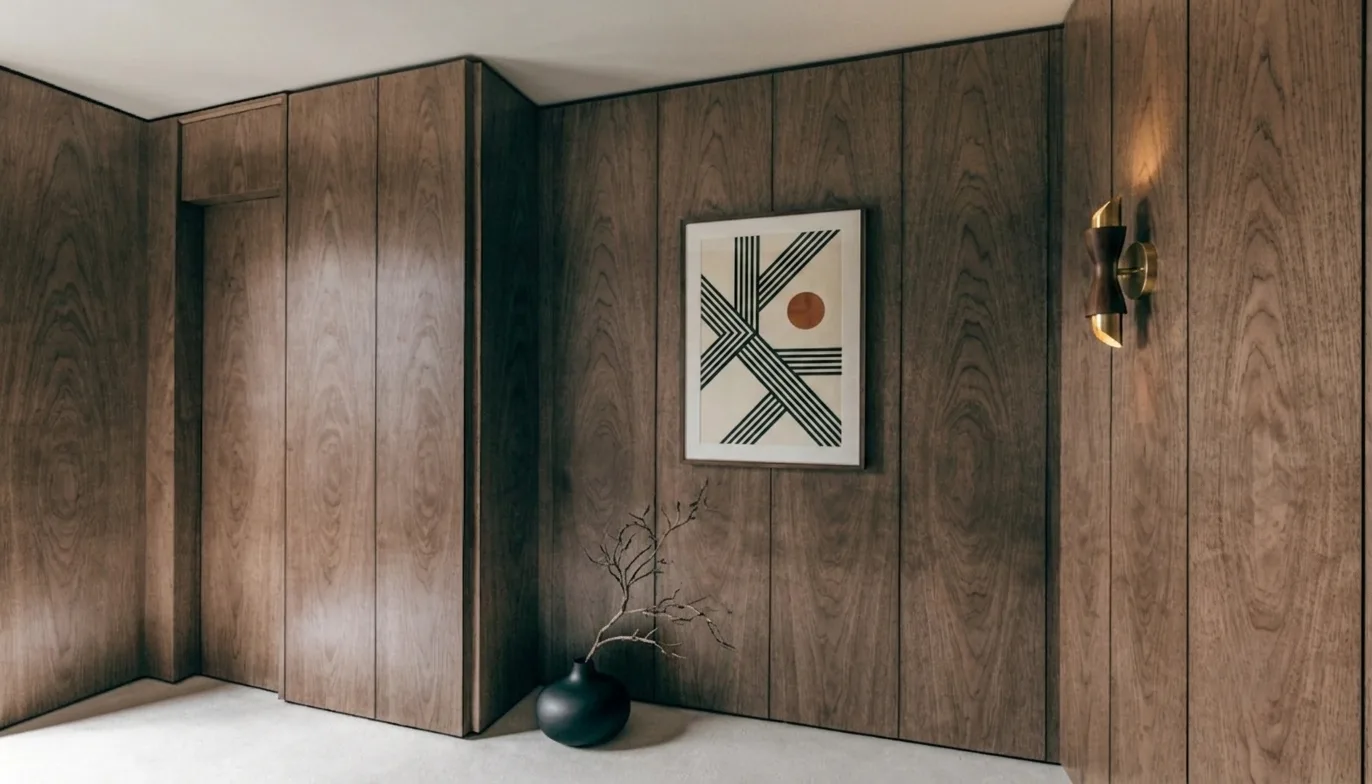
Boiserie is wood panelling that clothes the wall as a system, not as added decoration. In its historical form it carried mouldings, panels and ornament. The contemporary neoclassical reading keeps the logic — proportion, rhythm, continuity — and removes the adornment. What remains is the discipline: a wall understood as composition, not as backdrop.
Well resolved, contemporary boiserie does three things at once. It orders the proportion of a room by imposing a vertical rhythm the eye reads as calm. It absorbs function — storage, concealed doors, services — without declaring it. And it gives wood the role it fills best in quiet luxury: to be present without asking for attention. It is the same conviction we develop when discussing quiet luxury interior design: classical structure without classical ornamentation.
Which wood is best for luxury interior design?
There is no better wood in the abstract; there is the right wood for each function. As an operational answer: oak for floors and high-traffic surfaces for its balance of hardness and restraint; walnut for furniture and cladding where the eye seeks depth; ash for pale, discreet luxury; and teak for wet zones for its stability against water. A project's quality is not measured by how expensive the species is, but by how well the species fits its use.
Solid or veneer? Solid on floors, structural joinery and exposed edges; veneer over a stable core on tall vertical panelling and continuous jointless surfaces. The correct veneer is not the cheap option: it is the technical one.
Patina as an Asset, Not a Defect
There is a final decision, and it is a matter of mindset. Wood is the only fine material that improves with use if chosen and finished well. Stone wears; metal scratches; open-pore wood patinates, and that patina is what no synthetic material manages to imitate.
Designing with high-end wood is, at heart, accepting time as part of the material. Specifying with a view to how the surface will look at five years, not at handover. The studio that decides well does not deliver a finished space: it delivers a space that begins to age well. That is the difference between a finish and a judgement.
Véline Interiors · Hospitality Design
If this way of deciding on materials fits your hotel or villa project, the conversation is open.
We specify wood for hospitality and residential projects that age with dignity, not ones that degrade with use.
Present your project →