There is one material in a wellness space that the guest registers without ever touching it. Not the travertine, the oak or the linen. The light. Before recognising a texture, the body has already responded to the temperature and intensity of what fills the room: it has tensed, or it has let go. That is why lighting in wellness spaces deserves to be treated as what it is — a design criterion with physiological and operational consequences — and not as the fixture catalogue chosen once the refurbishment is already settled. This article sets out the decisions that matter, zone by zone, in the language of an interior design studio rather than a manufacturer.
Light Does Not Create Atmosphere: It Regulates the Body
The underlying shift in wellness design over recent years is that light stopped being understood as aesthetics and started being understood as biology. The human retina contains cells — the ipRGCs — that do not serve sight but instead tell the brain's internal clock what time it is. They respond above all to blue light, abundant in daylight. When they receive that signal, the body suppresses melatonin, the sleep hormone, and releases cortisol, the hormone of activation.
This is not brand theory. The 2017 Nobel Prize in Physiology or Medicine was awarded to Jeffrey Hall, Michael Rosbash and Michael Young precisely for decoding the molecular mechanisms of the circadian rhythm. And the work of Mariana Figueiro and Mark Rea at the Lighting Research Center of Rensselaer Polytechnic Institute has measured how cool morning light raises cortisol and how its absence in the evening allows melatonin to rise. Warm evening light does not "feel" more relaxing: it is more relaxing, at a hormonal level.
The consequence for design is direct. A wellness space lit with cool, flat light is asking the body to activate at the very moment the guest has paid for the opposite. Correlated colour temperature (CCT), measured in kelvin, is the first lever: 2700K is a warm, amber light; 4000K is neutral; above 5000K it enters cool, daytime territory. In a spa, most of the journey should sit between 2200K and 3000K.
Not Every Wellness Area Calls for the Same Light
The most common mistake is treating the spa as a single atmosphere. A well-designed wellness space is a sequence of zones, and each has a distinct physiological role. Levelling the light across all of them levels experiences that should feel different.
Reception and transition. This is the crossing point from the hotel. Here the light can be a little more present — the guest is still "in the world" — but it must announce the descent: warm, at medium levels, without the commercial brightness of the lobby. It is the first sentence of the journey.
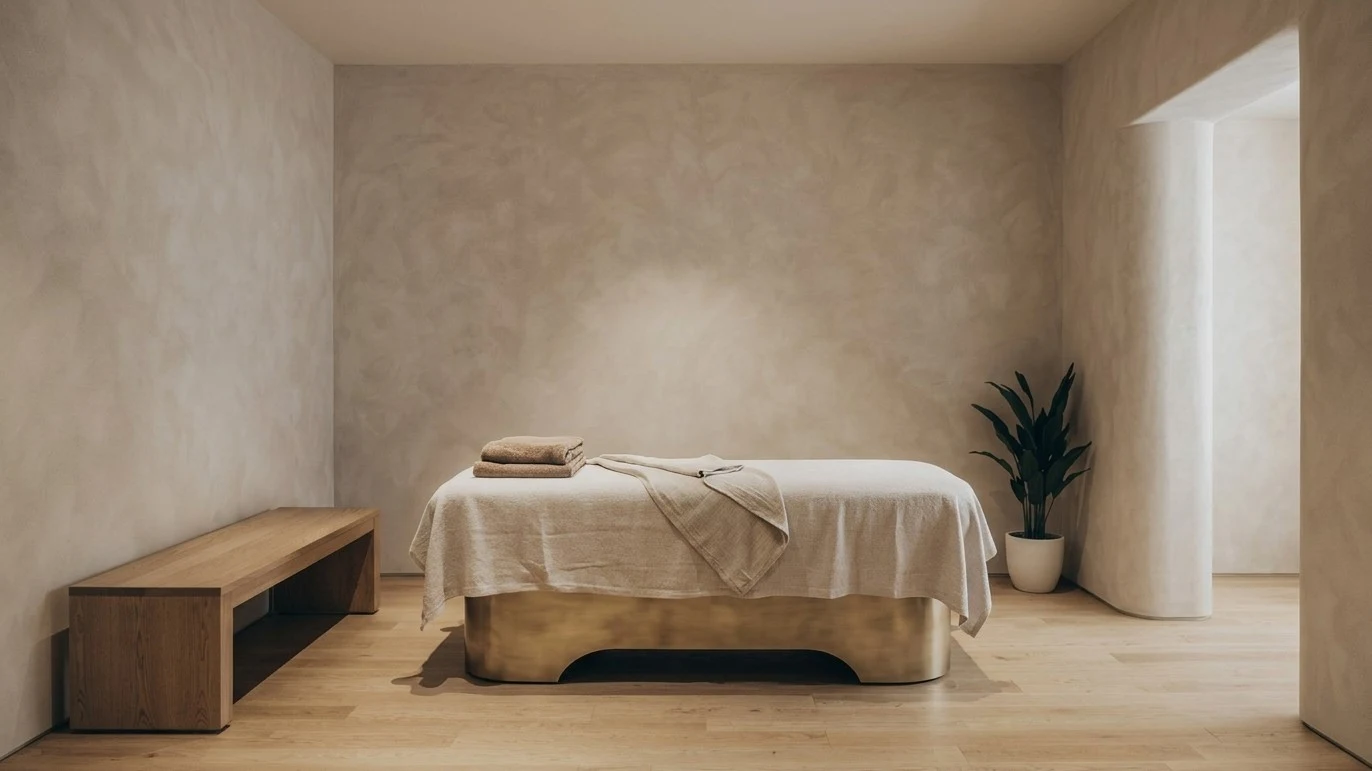
Treatment room. The critical decision is twofold. General light should be warm, diffuse and dimmable, but never placed as a direct downlight over the face position: no one relaxes with a spotlight above their eyes. And the colour rendering index (CRI) — a 0-to-100 scale measuring how faithfully a light shows true colours — must be high, above 90, because the therapist needs to read the real tone of the skin. Warm light, high fidelity, zero glare.
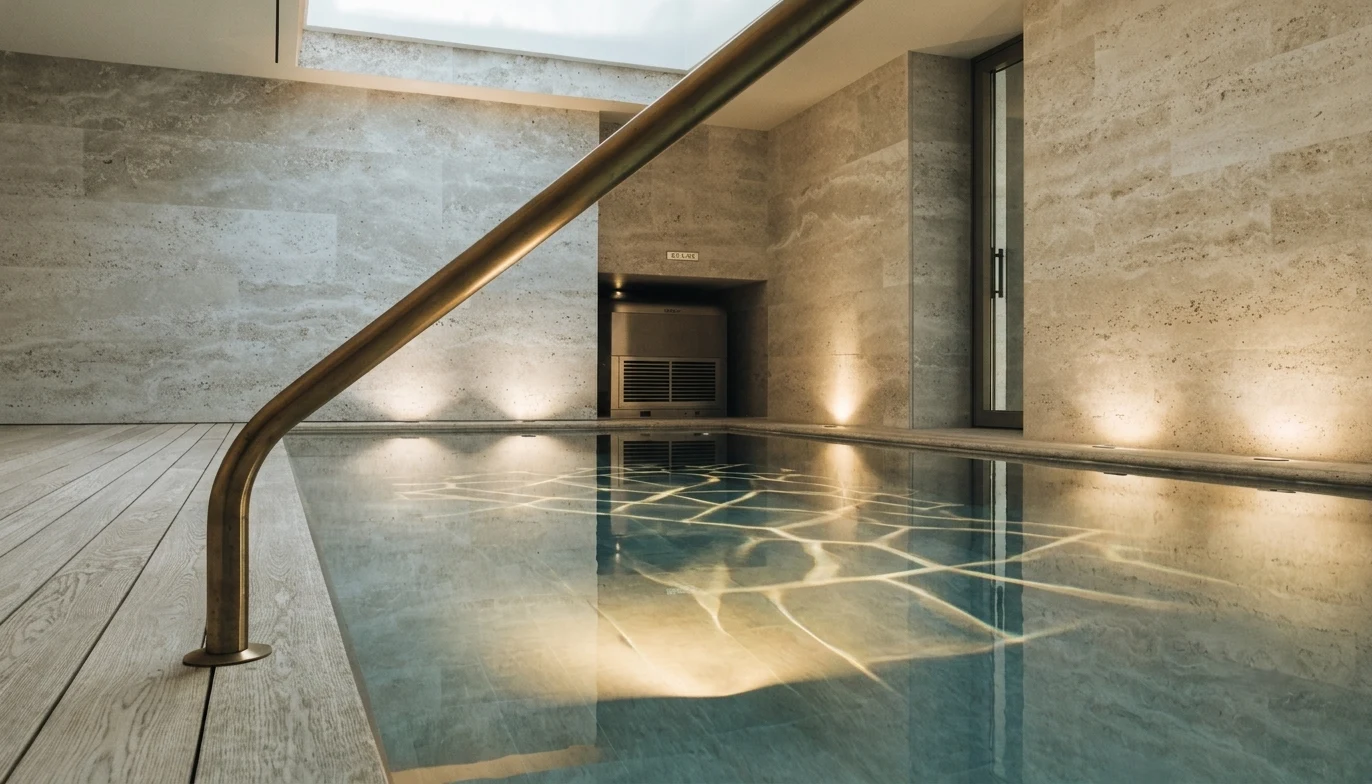
Wet areas. Indoor pool, steam, sauna. Here safety governs before aesthetics: fixtures need an adequate IP protection rating (the IEC 60529 standard classifies resistance to water and dust), and immersion zones demand high values. Done well, this goes unnoticed; done badly, it is a distracting reflection on the water or a seal that yellows. The light should be integrated into the material — grazing the travertine, glowing beneath the water — not hung from it.
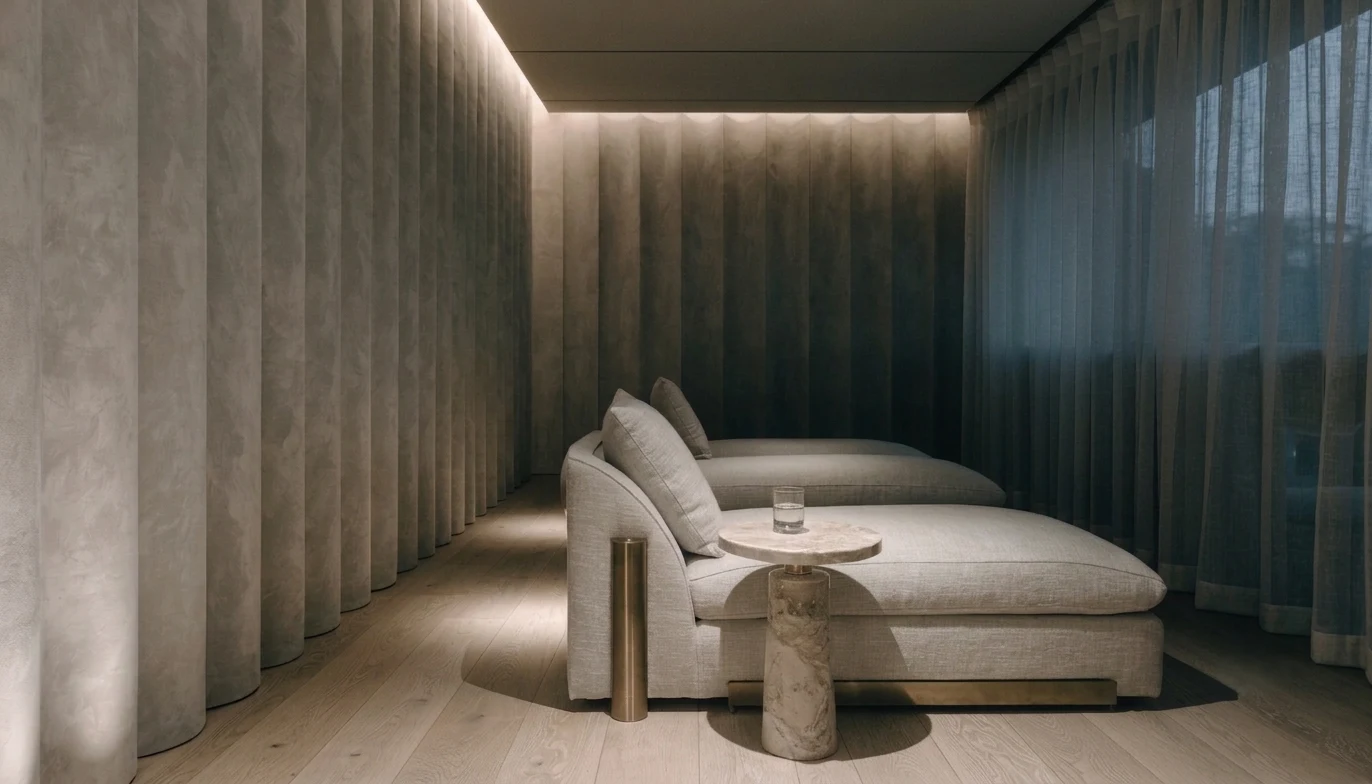
Relaxation area. The destination of the journey. Here light reaches its lowest and warmest point, between 2200K and 2700K, layered across several levels — never a single overhead source — to produce soft shadow and a sense of refuge. This is the zone where the guest decides whether to return. For the fitness area — an activation zone with the opposite lighting logic to the spa — see our analysis on hotel gym design.
Lighting Scenes, Not Fixtures
The trend shaping hospitality design in 2026 can be summed up in a phrase now circulating in the trade press: lighting scenes, not fixtures. The idea is to stop counting how many light points a space has and start counting how many distinct moments it lives through across the day.
In practice, each wellness zone should have three or four programmed scenes — morning, day, evening, night — varying intensity and colour temperature in a coordinated way. Two technologies make this possible. Warm-dim is a fixture that, as it dims, also lowers its colour temperature, mimicking how the sun turns amber as it sets: at 100% it gives 2700K, at 10% it drops to 1800K, like a candle. Tunable white allows the colour temperature to be shifted from warm to cool with separate control, useful in multipurpose rooms serving yoga in the morning and meditation at dusk.
All of it is governed by a DALI control system — a digital protocol that addresses each fixture individually and stores scenes — so staff change the mood with a single button, without relying on someone remembering which dimmers to touch. Without control, the finest fixture in the world stays on its factory setting.
The Mistake Almost Everyone Makes
On site, the point where the experience most often breaks is neither the treatment room nor the pool. It is the changing room. It is the last zone anyone thinks about and is usually resolved with cool, powerful overhead light — the same logic as an office washroom — because "you have to see properly". The result is that the guest steps out of an hour of calm, looks into a mirror lit like an operating theatre, and the entire preceding effort dissolves in thirty seconds.
The studio criterion is to treat the changing room as part of the emotional journey, not as a technical cupboard. Warm light here too, with a good level at the mirror but high-CRI and glare-free, and an accent point that avoids the flat effect. The coherence of the light across the whole route — from reception to the exit changing room — is what makes a space remembered as serene. A single cold link breaks the chain.
Light resolves half of a wellness space's sensory experience. The other half is what the ear perceives at the same instant: if echo competes with the light scene that's been programmed, the sense of calm breaks just as it does with a cold spot in the changing room. We cover this in wellness space acoustics design.
What Colour Temperature Is Best for a Spa?
For most of a spa, between 2200K and 3000K — that is, warm light. The relaxation area calls for the lower end (2200K–2700K); treatment rooms allow a slightly higher level while staying warm (around 3000K, with CRI above 90 to read skin tone properly); only staff work areas, unseen by the guest, justify neutral temperatures. The practical rule: the further the guest moves towards rest, the lower and warmer the light should be.
Can Circadian Lighting Be Added to an Existing Spa?
Yes, and without major building work in most cases. The key is not breaking ceilings but replacing fixtures with warm-dim or tunable white models and adding a DALI control system to govern the scenes. In an operating space, this upgrade can be phased — starting with the relaxation area and treatment rooms, where the impact on the guest is greatest — without closing the whole wellness area.
Light as a Decision, Not a Finish
A wellness space is judged by how it feels, and light is the factor the body reads first. Treating it as the final chapter of the build — choosing fixtures over a plan already closed — means giving up the most powerful tool design has to produce real rest, and with it the rate and the repeat visits that sustain the operation. In Iberia, properties such as the Longevity in the Algarve or Casa de São Lourenço in the Serra da Estrela have understood that wellness is not a room but a condition of the building. Light is where that condition begins.
If this criterion fits your hotel or villa project, the conversation is open. Let's talk.
Véline Interiors · Wellness Design
Have a wellness project in hand?
Véline Interiors works with boutique hotels, high-end villas and developers who want light to be the first design criterion, not the last finish.
Present your project →